Home Blog Page 106

5 Best Portuguese Soccer Players

0

Like fado and wine, soccer is vital to Portugal’s cultural heritage. Some of the best soccer players in the world have come out of Portugal and played for the national team.

While worldwide, Cristiano Ronaldo is most well known, there are plenty of Portuguese players that have, throughout the decades, put Portugal on the map. Let’s take a look at our 5 best Portuguese soccer players. 

Bear in mind, this list is very debatable. You might disagree with the order or even feel like we left someone out. Let us know in the comments below who your top 5 Portuguese soccer players are!

1. Cristiano Ronaldo

Cristiano Ronaldo is not just the best Portuguese soccer player, but perhaps the best in the world (Sorry, Messi fans). Originally born in Funchal, Madeira, CR7 is the captain of the Portugal national team and a forward for Manchester United.

Scoring over 807 goals in his career, Cristiano Ronaldo is the highest goalscorer in the history of men’s soccer. He is also one of the fastest soccer players in the world. 

Along with winning 32 trophies in his career, Ronaldo has won five Ballon d’ors. He was also ranked the world’s highest-paid athlete by Forbes in 2016 and 2017, as he is the first footballer to earn 1 billion dollars in his career.

But where did Cristiano Ronaldo start his career? He began his soccer career in Sporting CP at a young age and then signed with Manchester United at only 18 years old. 

Photo by Jan SOLO (Flickr)

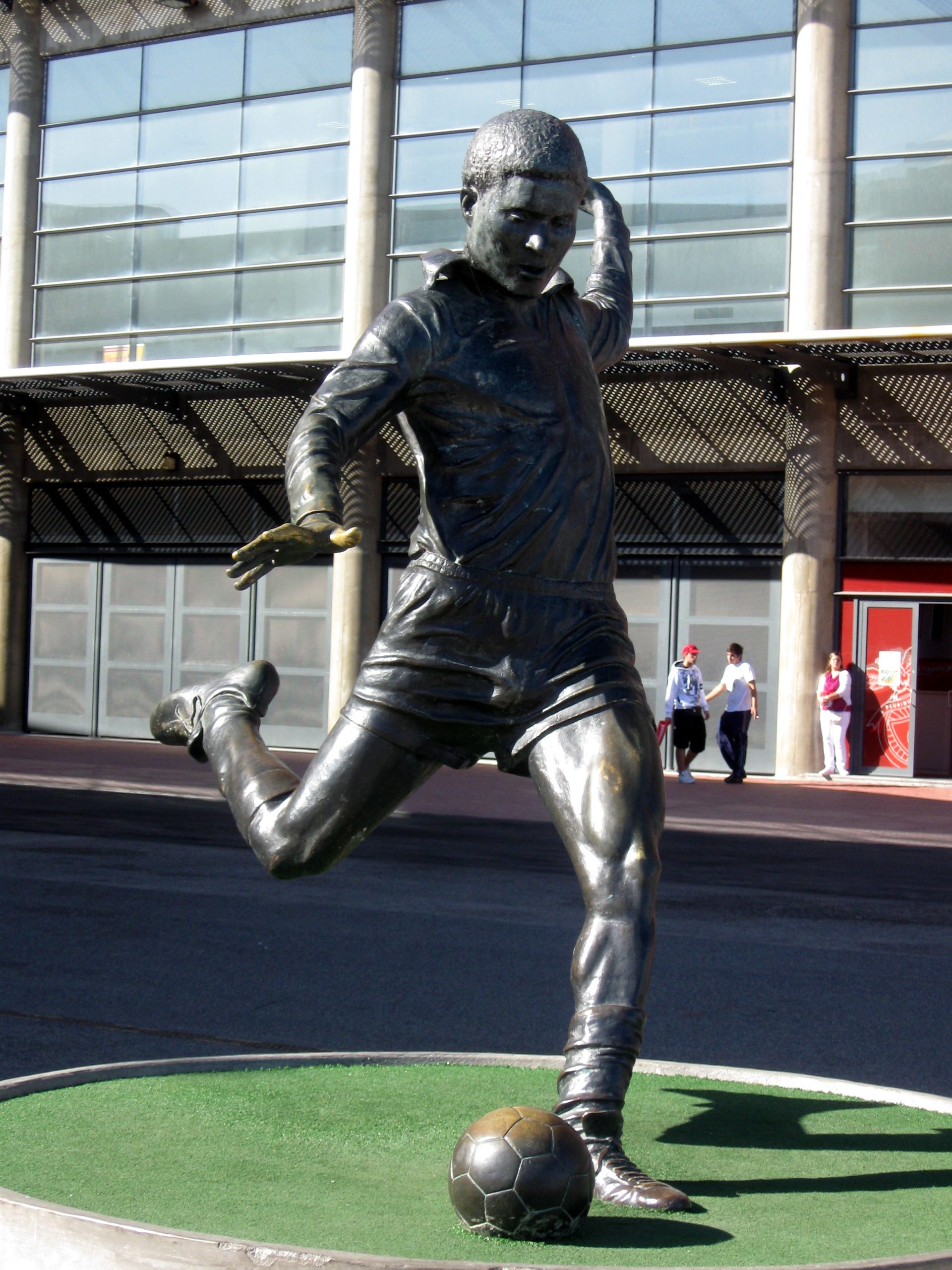
2. Eusebio

Also known as “the Black Panther” Eusebio was a Portuguese soccer player born in Maputo, Mozambique. Many know him as the best Portuguese soccer player of all time, as well as the best player in Benfica. 

Throughout his career, he scored 733 goals in 745 games. He helped Portugal reach third place in the 1966 FIFA World Cup and won a Ballon d’Or in 1965. Eusebio was also named European Footballer of the Year In 1965.

Eusebio only retired in 1979, playing until the age of 37 years old. After retirement, he remained an ambassador of football.

He was even elected the 9th best footballer in the 20th century by IFFHS. In 2003, he won Gold Player of Portugal by the Portuguese Football Federation. 

Eusebio passed away on January 4, 2014, of heart failure at 71 years of age. The likes of Cristiano Ronaldo, Jose Mourinho, and Greg Dyke paid tribute to him. The Portuguese government even declared three days of national mourning!

Photo by Erik Cleves Kristensen (Flickr)

3. Figo

Luis Filipe Madeira Caeirgo Figo, known only as Figo had to be in our top three. He is said to be the leader of Portugal’s “Golden Generation” in the 1990s.

Figo has an incredibly successful career, winning multiple trophies such as the Portuguese CUP, one UEFA Champions League title, and more. He scored 32 goals for Portugal and helped the team reach the final of the Euro 2004.

Figo started his career at Sporting CP, but has also played for Real Madrid, Barcelona, and Inter Milan. He announced his retirement in May 2009, playing his final game for Inter Milan against Atalanta that same month.

In 2015, Figo announced he wanted to run for the position of FIFA president, endorsed by David Beckham and Jose Mourinho. He promised to invest in grassroots football. However, he later withdrew his campaign. 

Photo by El Hormiguero (Flickr)

4. Fernando Peyroteo

While less known by young people, Peyroteo was one of Portugal’s best soccer players. He spent his entire career with Sporting CP, which is unusual today. Peyroteo scored 544 goals in his career and won 11 major titles. 

He was born in Angola and first played at Sporting CP in Lisbon in 1937. In his first year, he scored 57 goals in 30 games, winning both the Lisbon Championship and the Taca de Portugal. 

At 31 years old, Peyroteo retired and opened a sportswear shop. He later moved back to Angola but then returned to Portugal to coach the Portuguese national team. After losing his second game in the 1962 FIFA World Cup qualifiers against Luxembourg, he was fired. 

Peyroteo then quit the world of soccer altogether. However, after a veterans game in Spain, he was injured and taken into surgery. Due to complications, one of his legs had to be amputated. 

He died at age 60 in Lisbon. 

5. Rui Costa

Rui Costa is to many, one of the best midfielders in the world. He has a vast career playing for Benfica, Fiorentina, and AC Milan. He was also the 34th president of Benfica, his home team. 

Rui Costa started his soccer journey early when he joined a football team in Portugal at 5 years old. He then played for youth squads up until the 1990s. He made his first debut for the Portugal national team in 1991 where he helped beat Brazil in the World Youth Cup.

He then went to Benfica where he helped the team win two trophies, as well as Florentina and Milan, where he played for five seasons.

Costa has many awards under his belt, including the Top Assists Award in the UEFA Champions League 2002 and the Footballer of the Year in 2007.

On May 2008, Rui Costa announced his retirement, playing his final game against Vitoria de Setubal for Benfica. 

After retirement, he remained in the football world. He was almost immediately made an administrator of Benfica and was elected president in 2021. 

Leonardo DiCaprio supports Portuguese youth suing 33 countries over climate change

0

Leonardo DiCaprio has expressed his support on Instagram for the movement of Portuguese climate activists suing 33 countries in the European Court of Human Rights. 

DiCaprio took to Instagram to celebrate the six Portuguese children, saying, “Young people in Portugal are fighting against powerful European governments to protect their homelands and livelihoods that have been destroyed by extreme conditions.”

The six activists are a part of the movement Youth 4 Climate Justice and are between the ages of 9 and 22. The young people from Portuguese have sued 33 countries in the European Court of Human Rights for their inaction in tackling climate change.

The activists believe “the climate crisis interferes with their right to life, respect, and even their right not to be discriminated against,” says DiCaprio. “The goal is to legally bind governments to increase emissions cuts locally and internationally,” his post reads.


View this post on Instagram


A post shared by Leonardo DiCaprio (@leonardodicaprio)

DiCaprio also reminded his followers of the Pedrogao Grande wildfires in 2017. In 2021, DiCaprio launched a documentary about the tragedy in Portugal. These wildfires were the deadliest in Portuguese history, with at least 66 deaths.

The six youth applicants first filed this case in September 2022. They are now preparing for a hearing before the 17-judge Grand Chamber against the 33 countries. We do not yet know the date for this.

The six Portuguese activists suing 33 countries over climate change are Mariana (9), Andre (13), Sofia (16), Martim (18), Catarina (20), and Claudia (22). Three of them are from Leiria, a region that has been hit by an increase in wildfires in recent years.

Health Minister of Portugal Marta Temido resigns

0

Marta Temido, the Health Minister of Portugal, presented her resignation letter to the Prime Minister this Tuesday as she “no longer has the conditions to remain in the position.” PM Antonio Costa has accepted her resignation request.

The announcement by the Ministry of Health was sent to the media in the early hours of Tuesday morning but did not add any other explanation.

However, her resignation came only a few hours after the report of the death of a pregnant woman on Saturday, after being transferred to another hospital due to a lack of vacancies.

Antonio Costa’s office also sent out an announcement at 1:29 AM saying that the PM “respects her decision” and thanks her for her hard work during the Covid-19 pandemic.

“The government will proceed with the reforms in place to strengthen the National Health Service (SNS) and improve the health care provided to all Portuguese people,” says the announcement. 

Marta Temido became Health Minister in October of 2018, succeeding Adalberto Campos Fernandos.

While many praised her role during the Covid-19 pandemic, she has been recently criticized for the closure of emergency services around the country. These closures have particularly impacted services related to gynecology and obstetrics.

Miguel Pinto Luz, the Vice President of the Social Democratic Party (PSD) said in a press conference that “this resignation represents the failure of the health politics led by the Socialist Party and PM Antonio Costa.”

Speaking about the current issues in the SNS, he said that “the cost has increased, we have never spent so much on health, but the quality has decreased.” “Millions were spent, but emergency services are closed, and appointments are postponed…”, he continues.

Pinto Luz criticized the government, saying that “a mother had to die who did not have access to emergency services in the largest hospital in the country for Temido to resign”.

On Saturday, a pregnant Indian woman that was vacationing in Portugal died after being transferred from Santa Maria Hospital to Sao Francisco Xavier in Lisbon. The woman had to be transferred due to a lack of vacancies in neonatology.

She needed an urgent c-section to save her life as she was suffering from severe preeclampsia and uterine growth restrictions.

The baby survived after an emergency c-section and is currently hospitalized at Sao Francisco Xavier Hospital.

Pregnant Indian woman dies after hospital transfer due to lack of vacancies in Lisbon

0

A pregnant Indian woman that was vacationing in Portugal died last Saturday after being transferred from Santa Maria Hospital to Sao Francisco Xavier in Lisbon. The woman was transferred due to a lack of vacancies in neonatology. The baby survived after an emergency c-section and is hospitalized at Sao Francisco Xavier Hospital.

The woman was 34 years old and around 30 weeks pregnant. According to the University Hospital Center Lisbon North (CHULN), she was first admitted to Santa Maria Hospital last Tuesday, August 23, at 2 AM and transferred to Sao Francisco Xavier that same day.

CHULN explained that “after normalization of arterial tensions and a significant respiratory improvement, she was transferred the same day to Sao Francisco Xavier Hospital, due to a lack of vacancies in neonatology, accompanied by a doctor and nurses.”

The Director of the Obstetrics Services at Santa Maria Hospital, Luisa Pinto, told CNN Portugal that the hospital only had two vacancies. The hospital allowed a mother pregnant with twins to remain, as the pregnant woman that eventually died was stable at the time. 

She needed to be transferred as the largest unit in the country did not have a vacancy to hospitalize the baby after labor was induced. The labor needed to occur to save the mother’s life as she had been diagnosed with severe preeclampsia and uterine growth restrictions.

During the transfer, the pregnant woman suffered a cardiorespiratory arrest that lasted 17 minutes. The medical staff tried to revive her during the trip, but when they arrived at Sao Francisco Xavier, she was in a profound coma.

Doctors were able to perform an emergency c-section when the pregnant woman arrived at Sao Francisco Xavier Hospital. The baby was born with 772 grams and is in intensive care for premature babies.

The mother remained in a coma for a few days until cerebral death was detected, and her death was then officially declared on Saturday afternoon. 

Press conference at Santa Maria Hospital

In a press conference at Santa Maria Hospital on Tuesday morning, Luisa Pinto and Clinical Director Luis Pinheiro said that the pregnant woman was stable at the time and that all the right conditions were in order for it to take place.

They also said that it was safer to transfer her rather than allow her to give birth at Santa Maria. Andre Graca, the Director of Neonatology of Santa Maria Hospital said that “the best transport is the mother’s uterus.”

Without vacancies, the baby could have arguably been born in Santa Maria and later transferred for care. However, Andre Graca argues this would be extremely risky in the first hours of the newborn’s life. 

When asked whether the mother would have survived if Santa Maria had more vacancies, Luisa Pinto said, “Probably not. Probably the same would have transpired. Although trying to revive someone in an ambulance is different than in a hospital…”.

She went on to say that it is not common for those with preeclampsia to go into cardiorespiratory arrest, so the situation was unexpected.

However, she says that due to the pregnant woman being foreign, the staff did not have her medical records about any previous pathologies. They will be investigating what happened.

Luisa Pinto also said that the pregnant woman could not speak English or Portuguese but was accompanied by her husband. 

Minister of Health Marta Temido resigns a few hours later

A few hours after this report was released in the media, the Minister of Health, Marta Temido, formally presented her resignation. Prime Minister Antonio Costa accepted her resignation request and informed the president. 

Temido has not mentioned the death of the pregnant woman in her resignation request. However, she has been recently scrutinized for the closure of emergency obstetrics services in various hospitals due to a lack of doctors. 

Cost of Living in Algarve: Faro Monthly Budget

Faro is located in the Algarve region in southern Portugal and is home to a vibrant expat community. Known for its year-round sunny weather, Faro has some of the warmest weather in the country and the best beaches in Portugal. 

But is it expensive to live in Faro? Portugal has a lower cost of living than major European countries such as the Netherlands, Italy, and France.

Although Faro is not the cheapest city in Portugal, it is more affordable than the capital Lisbon. Rent is around 20% cheaper, and day-to-day costs such as restaurant prices are also more affordable than in Lisbon.

If you’re considering Faro as a permanent or temporary home, let’s take a look at the average monthly budget for expats without children, families, and digital nomads.

Guide to Faro

Cost of Living in Faro for an Expat 

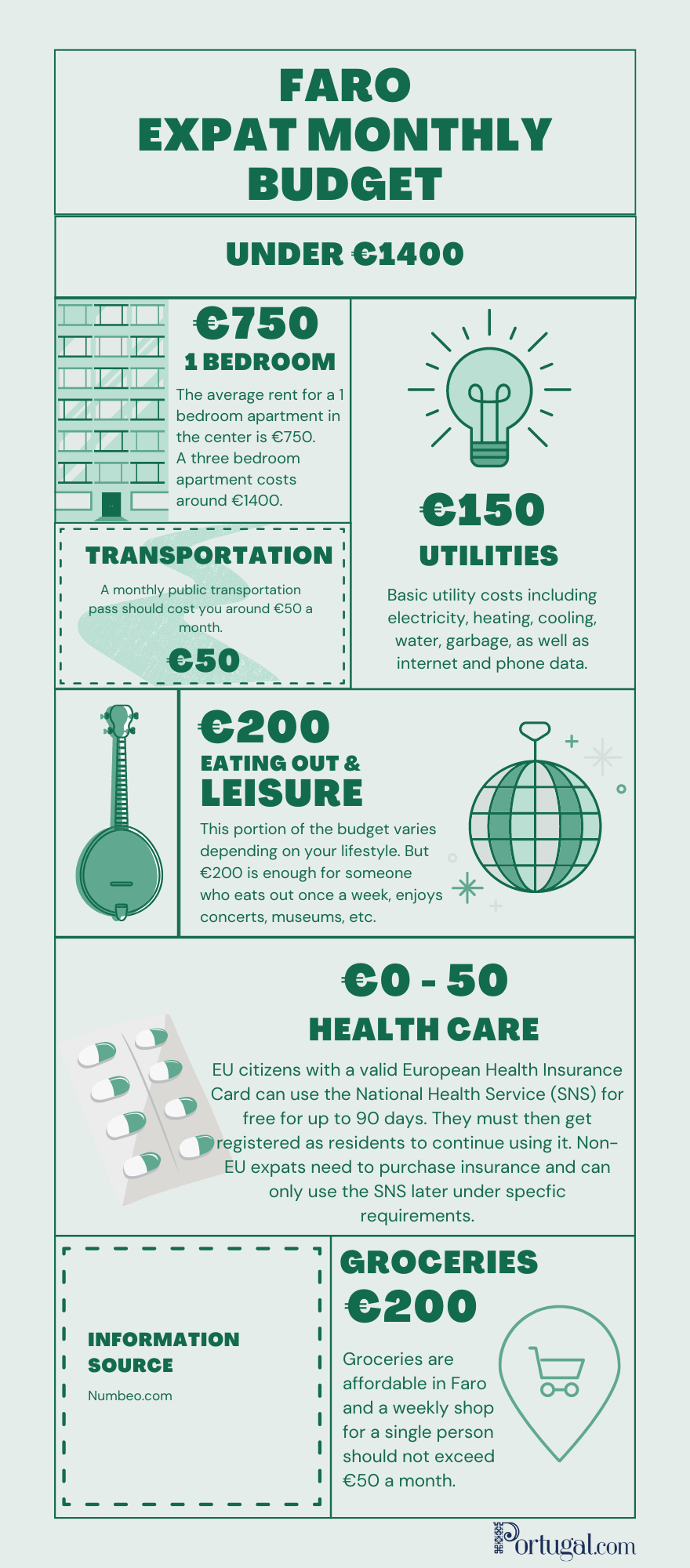
The monthly budget for an expat in Faro is less than €1400.

A one-bedroom apartment costs around €750. However, you can save here by renting a room for less than €400.

A monthly transportation pass is around €50 or less for buses. You can also get a train to many cities from Faro, such as Lisbon and Porto. 

Utilities cost around €150, including phone data and cable TV.

For exploring Faro, eating out at your favorite restaurants, and exploring the nightlife, budget around €200 a month. You can easily spend less or more, depending on your lifestyle. 

Groceries for a single person average out at around €50 a week.

Health care could add to your monthly budget in Faro. EU citizens with a valid European Health Insurance Card can use the National Health Service (SNS) for free for up to 90 days in Portugal. This allows them time to get registered as legal residents to continue using the public health system.

However, non-EU citizens are only entitled to use the public health system if they are employed and pay social security in Portugal, having to be registered as legal residents as well.

Even if this is the case, they must purchase private health insurance to cover medical care before arriving in Portugal and becoming a legal resident.

Cost of Living in Faro for a Digital Nomad

The cost of living in Faro for a digital nomad is at least €1000 a month.

If you are looking to stay at a private Airbnb, this could almost triple your budget as it will cost anywhere between €1500 and €2000 a month.

A shared room in a hostel starts at around €15 a night, and a private room is around €40 a night. 

Renting a desk at a co-working place in Faro can cost between €100 to €250 a month. Transportation costs around €50. There are plenty of buses in the city and a train station connecting you to other main Portuguese cities.

Budget at least €200 for leisure such as eating out, nightlife, and trips to nearby beaches and attractions.

If you are looking for a full tourist experience and looking at tours, you will need more than this for the month.

Food can easily max out your monthly budget. If you want to save and have a kitchen at your disposal, a weekly shop shouldn’t cost more than €50.

However, if you plan to eat out, an affordable meal is around €10 nowadays.

Cost of Living in Faro for a Family of Four 

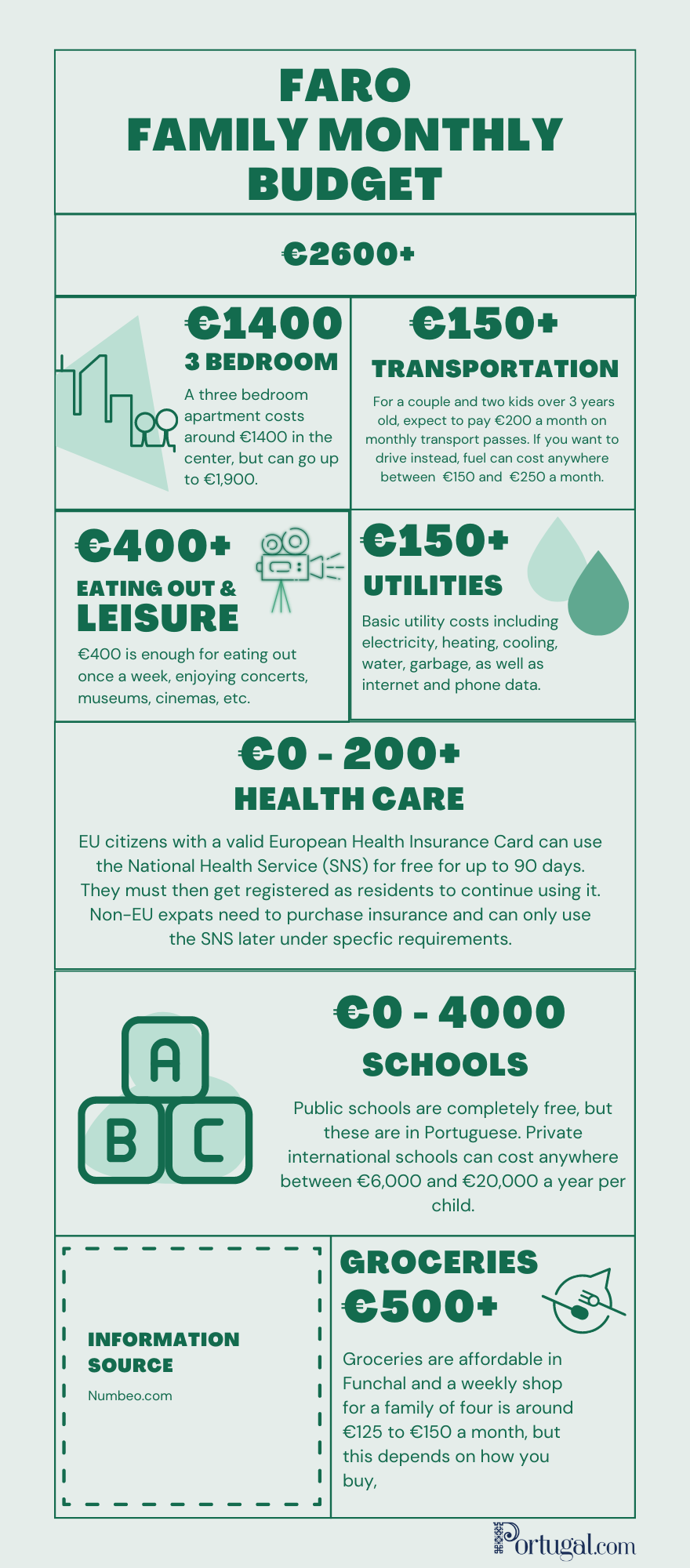
Kids are always more expensive. However, Faro is can be an affordable alternative to other European cities. Expect to spend at least €2600 a month for a family of four in Faro. 

A three-bedroom apartment in Faro will set you back around €1400. However, prices can go up to €1900 or more, depending on the apartment type and amenities. 

Budget around €200 a month for monthly transport passes. However, it is definitely more convenient for a family of four to own a car and drive. Fuel will cost you anywhere between €150 and €250 a month. 

Utilities cost around €150 and include electricity, heating, water, etc. However, this can be much higher in the winter or depending on your family’s consumption.

Groceries for a family of four in Faro should cost around €125 to €150 a week, so budget at least €500 a month.

If you need to purchase health insurance for the whole family, this will cost you at least €200 a month.

However, you might be eligible to use access to healthcare for free. EU citizens with a valid European Health Insurance Card can use the National Health Service (SNS) for free for up to 90 days in Portugal. After becoming legal residents, they can continue to use the SNS.

However, non-EU citizens are only entitled to use the public health system if they are employed and pay social security in Portugal, having to be registered as legal residents as well.

If you want your kids to attend an international school, this will cost you! While public schools are free, private international schools can cost between €6,000 and €20,000 a year. You could pay around €2000 a month for two kids just for education. 
Huge dinosaur skeleton found in man’s backyard in Portugal

0

The skeleton of a possible sauropod dinosaur was discovered back in 2017 in a man’s backyard in Pombal, Portugal. The skeleton is now reported to possibly be the largest dinosaur skeleton ever found in Europe at 12 meters high and 25 meters long.

Five years ago, a man noticed fragments of fossilized bones in his backyard in Pombal while carrying out construction work. Since then, an international research team has been studying the findings and conducting excavation campaigns on site.

In August of 2022, Portuguese and Spanish paleontologists realized that the remains could correspond to the largest sauropod dinosaur discovered in Europe. 

Dr. Elisabete Malafaia, a postdoctoral researcher at the University of Lisbon, has said that this finding is incredibly rare, as such preservation is unusual for large-sized dinosaurs. 

She said in a statement, “It is not usual to find all the ribs of an animal like this, let alone in this position, maintaining their original anatomical position. This mode of preservation is relatively uncommon in the fossil record of dinosaurs, in particular sauropods, from the Portuguese Upper Jurassic”.

Parts of the skeleton have been collected, including vertebrae and ribs. The researchers found “the largest ribs of a sauropod that are currently known in Europe” and one of the largest worldwide. Each rib measured about three meters in length. 

The skeleton is thought to be of a possible brachiosaurid sauropod dinosaur, a large species that lived from the Upper Jurassic to the Lower Cretaceous around 100 million years ago. 

The preservation characteristics of the fossils indicate to the researchers that there might be other parts of the skeleton around. This hypothesis will be tested in future excavations this year.

Four Coldplay concerts already sold out in Portugal

0

The promoter Everything Is New confirmed a fourth date for Coldplay in Coimbra on Thursday after the first three dates sold out. The fourth date has already sold out! Each concert will have 50,000 people in attendance. Coldplay will be performing in Portugal on May 17, 18, 20, and 23 of next year.

These four concerts are Coldplay’s first return to Portugal in over a decade after a concert in Porto. 

The president of Ticketline, Ana Ribeiro, told Lusa that the demand for Coldplay tickets hit a historic level, never seen before in Portugal.

Ticket prices initially cost anywhere between €85 to €500 for the VIP Lounge. A single person could only buy 6 normal tickets or 4 VIP packages.

Everything Is New does not advise people to buy tickets on the resale market. However, due to all tickets being sold out, many are having to do so. There are several tickets being resold for hundreds of euros a piece.

The Portuguese Revolution of 5 October 1910

When you think of a Portuguese revolution, the 25 of April is the most widely known. However, the Portuguese revolution of 1910, also known as the 5 October 1910 revolution, is just as historically significant. This revolution overthrew the Portuguese monarchy and replaced it with the First Portuguese Republic. 

By 1910, the monarchy’s power was dwindling. From the King’s assassination in 1908 to the 1890 British ultimatum, there was widespread disapproval of the monarchy. The people wanted the kingdom to adapt to modern times and the monarchy was no longer looked upon as a symbol of hope.

Instead, the Republican Party was gaining popularity, presenting itself as having the ability to improve Portugal and proved successful in the 1910 revolution.

Let’s take a look at what paved the way toward the abolishment of the monarchy, the 1910 revolution in more detail, and its aftermath. 

Background: Critiques of the Monarchy & the Portuguese Republican Party

The Kingdom of Portugal was not looking good, nor were people’s views of the monarchy. This became apparent in 1890 with the British Ultimatum. This was when the British government sent the Portuguese an ultimatum, demanding that they retreat from the Pink Map project.

The Pink Map project was Portugal’s claim of sovereignty over the lands between Angola and Mozambique. 

Portugal complied rapidly, leading the people, as well as the elite, to feel humiliated about the country. On top of that, a financial crisis arose which even worsened the disapproval of King Carlos I started.

At this time, the Republican Party was growing. Republican candidates were voted for in the government elections in 1890. These hugely disapproved of the monarchy and the King. Members of the public began supporting the party.

The Portuguese Republican Party was created in 1876 and had as its main objection to overthrowing the monarchy. There were issues within the party, with members disagreeing about the internal politics and ideology.

However, the party decided it wanted to distinguish itself from the Portuguese Socialist Party which was more geared toward the rights of the working class.

Rather, the Republican Party replaced a more socialist attitude in favor of more simple democratic principles, with the help of Teofilo Braga. This allowed the party to attract the small and medium bourgeoisie, which was one of the largest groups supporting the republicans.

Antonio Jose de Almeida was a student at the University of Coimbra at the time and published an article criticizing the king, leading to his imprisonment. This man would one day become President of the Republic in 1919.

On February 1, 1908, a major event happened that consolidated the path toward the revolution two years later. While traveling to Lisbon from Alentejo where King Carlos I and his eldest son were vacationing, these two were killed.

They traveled on an open carriage and when greeting the crowd at Lisbon’s Commerce Square, a group of men shot them both multiple times.

Two of the attackers, Manuel Buica and Alfredo Luis da Costa were killed, while others escaped.

Portugal was left without a King and his heir. 

The 1910 Revolution in Portugal

After years of turmoil and disapproval of the monarchy, on October 3 1910 the Republican uprising took place in Lisbon. At first, many republicans did not want to take part in the uprising, however, enough participated to be successful. There were nearly two thousand armed soldiers and sailors rebelling between October 3 and 4.

The government was expecting military help from other parts of the country on October 4, but this never arrived. The rebels had also managed to control the military so that they would not receive this help.

They disconnected telegraph lines and cut communication with units outside of Lisbon, so these never received the orders. Rebels also cut off railway tracks so that troops outside of the capital could never arrive on time. While it was still possible that the military from Setubal could arrive, the rebels were able to control the Tagus rivers with their ships.

The military was not able to fight the rebels, having to declare the Republic and fall of the monarchy at 9 am of the next day in Lisbon’s City Hall by republican Jose Relvas.

There were many casualties in this revolution, it was not a peaceful one. From bombings and shootings, many did not sustain their injuries. However, it is not known how many people died in the uprising. 

Aftermath of 1910 Revolution 

Provisional Government

After the proclamation of the Republic, a provisional government was nominated by the members of the Portuguese Republican Party. They would govern Portugal until a new constitution was approved.

The provisional government was led by Dr. Joaquim Teofilo Braga as President. The other men that made up the government were:

  • Interior Minister: Dr. Antonio Jose de Almeida
  • Justice Minister: Dr. Afonso Costa
  • Treasury Minister: Basilio Teles
  • War Minister: Antonio Xavier Correia Barreto
  • Navy Minister: Amaro Justiniano de Azevedo Gomes
  • Foreign Relations Minister: Dr. Bernardino Luis Machado Guimaraes
  • Public Works Minister: Dr. Antonio Luis Gomes

The new provisional government took important steps that made it distinctive from the government under the monarchy. They made operations with the victims of the monarchy and pardoned anyone prosecuted for crimes against the state or religion. 

The government also closed down convents, prohibited religious teaching in schools, and adopted secularization. Divorce was even allowed, as was the equality of marriage rights of men and women. The Catholic church no longer held the power it once did in government which was met by great anger.

Press laws were altered with less censorship and noble and royal titles were eliminated. A major step toward labor rights was started, the right to strike. Overseas colonies were granted more autonomy, while colonization remained.

Perhaps the largest symbolic change in Portugal were the new national symbols. The national anthem and flag were altered, and the escudo, a new currency was adopted.

Meaning of the Portuguese Flag

The First Portuguese Republic

The provisional government had power until June 19, 1911 when the National Constituting Assembly was launched after an election. The Political Constitution of the Portuguese Republic was approved two months late.

The first constitutional president of the Republic was also elected, Manuel de Arriaga on August 24. The provisional government resigned after more than 10 months, and the start of the First Portuguese Republic began.

The First Portuguese Republic lasted sixteen years and saw eight presidents. In Portuguese history, it signifies a transition between the Kingdom of Portugal under the monarchy and the dictatorial Estado Novo. 

The Presidents of the First Portuguese Republic

  • Manuel de Arriaga (1911-1915)
  • Teofilo Braga (1915)
  • Bernardino Machado (1915-1917 & 1925-1926)
  • Sidonio Pais (1918)
  • Joao do Canto e Castro (1918-1919)
  • Antonio Jose de Almeida (1919-1923)
  • Manuel Teixeira Gomes (1923-1925)

The First Republic ended with a Coup d’etat in 1926, called the 28 May Revolution. This revolution was a military coup of a nationalist ideology that put an end to the First Portuguese Republic.

It essentially started almost five decades of authoritarian rule under the Ditadura Nacional (National Dictatorship) that would in 1933 lead to the Estado Novo. The Estado Novo only ended on April 15, 1974, with the Carnation Revolution.

Join our FB group Portugal Travel & Living for all things Portugal

Less than 500 students sign up to free transport in Lisbon

0

Only 447 young people have signed up for free transport in Lisbon in the first week of the measure, reports CNN Portugal. In contrast, almost 6,000 elderly people in Lisbon have signed up for free transport.

The measure was rolled out for elderly people in Lisbon on July 25. After almost a month of the measure being available to the elderly, over 20,000 people over the age of 65 signed up.

Young students between the ages of 13 and 23 years old have only been able to sign up since August 16. These can start enjoying free transport in September.

Of the 447 young people that signed up, 318 were between the ages of 13 and 18. Only 129 were between the ages of 19 and 23.

However, the measure excludes those with a fiscal residency in the municipality, which includes relocated students that benefit from scholarships. 

The Social Action Services (SAS) from the University of Lisbon have criticized the fiscal residency factor. SAS said that “economically disadvantaged students, with a fiscal residence outside of Lisbon, including those living away from their families,” will not be able to benefit from free transport. 

Lisbon City council said that the measure “will be permanently evaluated and monitored to look for more solutions, whenever they are possible.”

The free transport measure was announced in April by the Lisbon city council. The Mayor of Lisbon, Carlos Moedas from the Social Democratic Party (PSD) celebrated this decision, reminding us that only a few European cities have taken this step to fight climate change.

The measure will cost around €6,266,000 in 2022, and for 2023, 2024, and 2025, should cost around €14,900,000 a year.

Getting a Portuguese Driving License

Are you looking to get a driving license in Portugal? This guide has everything you need to know about getting a Portuguese driving license, from exams to classes. Keep in mind that you are unlikely to obtain a license in less than six months in Portugal, particularly if you need the teaching to be in English. 

Getting your driving license in Portugal can cost anywhere between 600 and 1,000 euros, depending on the driving school of your choice and how well you’re progressing. If you need extra classes or fail exams, the cost can be much higher. 

Guide to Driving in Portugal

Types of Driving Licenses in Portugal

 There are multiple types of driving licenses in Portugal. Take a look at the graph below. 

Who can get a driving License in Portugal?

General Age Requirements (A, A1, A2, and B)

While in Portugal, people under 18 cannot obtain the common B license for light vehicles, 16-year-olds can obtain the B1, AM, and A1 article. The B1 license refers to heavy quadricycles called microcars. The A1 license refers to motorcycles up to 125 cm2 and with a power rating up to 11 kw. The AM article refers to mopeds under 50 cm3.

From the age of 18, you can obtain an A2, B, and BE license. An A2 category license refers to motorcycles with a power rating up to up to 35 kw, as well as category AM and A1 vehicles. 18-year-olds can also get a B category license for light vehicles and a BE license which includes a trailer. 

A category A license can be obtained for motorcycles with a cylinder capacity up to 125 cm3 and a power rating up to 11 km if the person has had an A2 license for at least two years or are 24 years old.

Driving School in Portugal

If you are a first-time driver, to obtain a driving license in Portugal, you must attend both practical and theory lessons and pass two tests which we will discuss soon. You will do so at a certified driving school in Portugal. 

If you don’t speak Portuguese, a translator might be available to translate the test into your language.

You will need to get a medical report done before admission to a driving school which can take up to two weeks to process.

Portuguese Driving License Exams

Before taking the driving exam, you legally need at least 32 hours of driving lessons at a driving school. Before taking the driving exam, you must also have passed the theoretical exam. To take the theoretical exam, you need at least 28 theoretical classes and 16 practical classes.

However, if you feel you are ready, you can request to have the theory exam booked. At the driving school, you will be given a theory book with everything you need to know called “Codigo de Estrada.” After the lessons, you will be asked to practice for the exam online.

In the theoretical test, you will have to answer 30 multiple choice questions in 35 minutes and can only get three answers wrong (Passing mark: 27 out of 30). This exam tends to be harder than the other exams.

The practical driving exam takes 40 to 50 minutes. You won’t be alone in the car with the examiner who will evaluate you as your instructor will also be in the car, as well as another person taking the test. 

Along with proving you can drive safely, you will be asked to parallel park and circulate a sidewalk. 

After the driving test is finished, the examiner will tell you if you passed your test. If so, you will pay a small account to issue your driving license, which you will receive in less than a month. You can drive right away with a provisional license.

If you do not pass the test, you will need to repay the registration fee for the test, which is around 90 euros.

Photo by Ben Mullins (Unsplash)

Foreign Driving License in Portugal

A driving license from a non-EU country is not recognized in Portugal. You must exchange it within 185 days of obtaining your residency in Portugal.

To change your foreign driving license for a Portuguese one, instead of getting a whole new Portuguese one, the process is simple. You can submit an application online and will have to pay a small fee, less than 40 euros. 

You will need the following documents:

  • A photocopy of a personal identification document
  • Tax identification number
  • A medical certificate issued by a doctor 
  • Favorable psychological assessment certificate issued by a psychologist for Group 2 drivers
  • A declaration issued by an issuing authority or diplomatic or consular authority, attesting to the authenticity of the driving license
  • A translation of the driving license, authenticated by the consular service of Portugal 

However, exchanging some driving licenses from certain countries in Portugal obliges you to take a practical driving test. 

Driving License Validity

A driving license’s validity depends on its category. For Group 1 licenses which include categories AM, A1, A2, A, B1, B, and BE, a license is valid for 15 years until you turn 50 years old. When you turn 60, it expires every five years. When you turn 70, it expires every two years. 

For group two licenses which include categories C1, C1E, C, CE, D1, D1E, D, and De, they expire every five years from the age of 40 to 65. You must then revalidate the license at 68. From age 68 and up, you must revalidate it every two years.

Revalidating Driving License

You must revalidate your driving license when it expires. You can do it online at the Institute for Mobility and Transport (IMT), at an IMT service desk, or citizen shop.

If you do it online, log in to IMT with your tax identification number (NIF) and your finances portal password.

If you need a psychological aptitude certificate (CAP) or medical certificate, these should also be submitted.

If you revalidate your driving license on location, you must submit your citizen card (or your NIF and identification number or residence permit), as well as the driving license that will be replaced.

It costs 27 euros to revalidate your license online until the age of 70 and less than 40 to do so online if you are over 70 years old. On location, it costs 30 euros until the age of 70 and 15 euros if you are over 70.

You need a medical certificate or psychological aptitude certificate (CAP) in the following scenarios:

    • Group 1 Light vehicles (M, A1, A2, A, B1, B, BE): From 60 years old or if your license has a 147 restriction that demands it.
    • Group 2 Heavy vehicles (C1, C1E, C, CE, D1, D1E, D, DE): Always

(Basic) Road Safety Rules in Portugal

Let’s go through the basic road safety rules in Portugal. The list is pretty long, but the rules are pretty much the same as in other European Union countries.

  • Cars drive on the right and can only overtake other cars on the left
  • Cars already in the roundabout have the right of way (or priority)
  • At a crossing, if there is no stop sign or traffic light, cars from the right have priority
  • You cannot cross a white line or double white lines
  • You need to stop at stop signs and red lights, even if there is no one coming
  • You can only use your phone in hands-free mode
  • Seatbelts are mandatory

Speed Limits

The speed limits in Portugal vary depending on the location, but there are three main speed limits.

  • 50 kilometers per hour in residential areas
  • 90 kilometers per hour on rural roads
  • 120 kilometers per hour on motorways

Whenever the speed limit is not one of these three, it will appear on a white and blue sign.