Over 90% of Portuguese territory is facing a severe or extreme drought. The last dry spell of this scale occurred in 2005 and it seems that the current drought is even more severe, threatening agricultural production and water supplies in mainland Portugal.
The lack of rainfall is affecting the whole of the Iberian Peninsula, leading to drought not only in Portugal but also in Spain. The month of January 2022 was the second-dryest month in Portugal since 2000.
In the past, droughts like these have caused massive fires throughout the country, particularly in the summer. Droughts are not completely uncommon in Portugal but have been increasing in the past 30 years, as the wider issue of climate change worsens globally.
The drought is predominantly impacting the northeast and southern regions of Portugal. Farmers in these regions are being hit the hardest financially and have requested aid from the government because of the damage done to grass which is necessary for the livestock industry. The government has done what it can to save water for the Portuguese, restricting the use of reservoirs for hydroelectric power production.
Portugal is one of the best places to live in the world. Internationals move to Portugal for the weather, culture, low cost of living, and all around high quality of life. Many seek to find a job and work in Portugal to enjoy all that the country has to offer. Recently, there has been a growth of foreigners working in Portugal, making up 3.2% of the working population in Portugal. This is still quite low in comparison to other European countries.
If you’re looking to work in Portugal, this is the guide for you. From how to find a job in Portugal, to labour rights, and taxes, we’ll equip you with all the information you need. Just keep in mind that the job market is highly competitive and salaries are quite low, particularly for young people. In 2020, youth unemployment reached over 25%.
How to find a job in Portugal?
If you would like to work in Portugal, the first step is to look for a job. Portugal is still recovering from the 2008 economic crisis so finding a job isn’t always easy breezy. However, if you have the right academic qualifications and past work experience, you can find a good job in Portugal.
Do keep in mind that most jobs in Portugal require you to speak Portuguese. Learning Portuguese will make it easier to find a job, as well as live in the country. However, there are many jobs out there, particularly in larger companies, that also tend to pay better salaries, that are English speaking. You can also live and work in Portugal remotely as many companies offer this opportunity.
To find a job in Portugal we suggest searching on the following websites:
Once you’ve found your dream job in Portugal, you need to make sure your application is solid. A lot of companies will prefer to choose a Portuguese candidate instead so that they do not have to go through the hassle of applying for a visa (if you are a non-EU citizen). Therefore, make sure you put all your effort into an application that makes you stand out.
The application process in Portugal is pretty straightforward. Usually, you will send your CV with a motivation letter. In your motivation letter, do not just repeat what is written in your CV. Speak about the skills that you developed throughout the years and your motivations for applying for the job. Along with letting your personality shine through, your future employer must understand why they should hire you and what you will contribute. Therefore, your motivation letter shouldn’t just reflect why you want the job, but why the company needs you in particular.
If you are selected for an interview, bring with you a copy of your CV and any educational certificates that could be beneficial. Before the interview, do your research on the job role and company. Nothing looks worse than you being caught not knowing enough about the company you are applying to. Since Portuguese people are warm and welcoming, be prepared to make small talk and engage in informal conversation. Your personal interaction with the interviewee means more than in other countries and could make or break a job offer. You might also need to take psychometric and psychological tests, particularly in a large company.
If the interview goes well, expect that HR will ask you for a few references such as previous employers or university professors. Speak with these beforehand to avoid an awkward phone call.
Photo by Cytonn Photography (Unsplash)
Portugal Work Visa: Do I need a visa to work in Portugal?
EU/EEA/Swiss Citizens
If you are an EU/EEA/Swiss citizen, you do not need a work visa to work or live in Portugal. But if you want to work in Portugal for longer than six months, you will need to get a Certificado de Registo (Residence Certificate). You can find out how to get a Residence Certificate here.
Non-EU/EEA/Swiss Citizens
If you are a non-EU national, you will need a work visa to work in Portugal. To get a work visa, you need to find a job in Portugal first. After you have found a job, your employer will apply for a Portuguese work permit by contacting the Portuguese Labor Authorities. If you are planning to work in Portugal for less than six months, you will get a short-term work visa. However, if you plan on working in Portugal long-term, for more than six months, you will then have to apply for a long-term work visa. Once the visa is secured, you must apply for a Portuguese residence permit.
Work Culture & Etiquette in Portugal
Like other Southern European countries, Portugal has a unique work culture, often times deemed to be too relaxed by internationals. Deadlines are often quite lenient and punctuality is often not at its best. The dress code will depend on the company and industry. In larger companies, the dress code will be formal, with men and women wearing suits and traditional workwear. However, in the last decade, many companies have adopted a more relaxed dress code. Even the ones with a formal dress code tend to have a casual day on Fridays.
Gift giving is common in a business environment in Portugal, particularly to customers and partners. This is not seen as a bribe in Portugal, but rather, a sign of respect. Do not reject gifts and do send a thank you note later on. Although much of the world no longer does this, Portuguese businesspeople commonly exchange business cards and are prone to networking in informal settings, such as long lunches with wine. However, in a professional setting, grabbing drinks socially with your coworkers is not common. As employees tend to work long hours, usually only getting home by 6:30 to 7:00 PM, they tend to prefer going home to their families. Still, you will occasionally be invited over to someone’s house for dinner. Make sure to bring a dessert or wine, this is common courtesy in Portugal.
Photo by Marten Bjork (Unsplash)
Labour Rights in Portugal
Even if you are not a Portuguese citizen, you have the same rights as a worker in regard to salary, working conditions, and social security.
New Labour Laws 2021
In November 2021, Portugal made global news by announcing a change to the labour law that makes it illegal for bosses to contact employees outside work hours. No texts, calls or emails. The new labour laws include other policies that were not as mediatized. For example, employers must now contribute to work from home expenses, such as internet bills. These new laws to tackle exploitation during the COVID pandemic only apply to companies with more than 10 employees. But these are relatively new. What are the other labor laws in Portugal?
Working Age, Working Hours & Holidays in Portugal
The minimum working age is 16 years old, but you can only get an employment contract without finishing school at 18.
The law states that the maximum working week in Portugal is 40 hours and the daily working period cannot exceed 8 hours. Workers also have the right to at least one day of rest per week. If a worker is working at night, they must be paid an increase of 25%. If a worker is working on a rest day or public holiday, they have the right to a 50% hourly wage increase.
Workers in Portugal are entitled to 22 working days of holidays, plus 12 mandatory public holidays and 2 optional ones. All of these days are paid. All workers also receive a Christmas allowance, essentially a 13th month salary that is equal to a month’s wage that must be paid by the 15th of December.
Parental Leave in Portugal
All workers have the right to parental leave, including paternal and maternity leave for men and women. In Portugal, you have initial and extended parental leave. With initial leave, a woman must take 90 days of her leave after childbirth and the remainder may be used before or after childbirth, totaling 120 days paid at 100%. Mothers MUST take at least six weeks off right after childbirth.
Fathers are entitled to 20 mandatory working days leave after birth where they get paid. The first five days can be taken right after birth and the other 15 must be taken within six weeks of the birth. The latter does not have to be taken consecutively.
After initial parental leave, parents can extend the leave to 180 days by adding three months, a period which is shared between the two parents at a rate of 83% of total pay. On the other hand, parents can also choose to extend the maternity leave alone to 150 days with no shared period at a rate of 80% total pay.
Do adoptive parents get parental leave in Portugal?
Yes. Adoptive parents can take adoptive leave if the child is under 15 years of age. The government states that each parent is entitled to 120 to 150 consecutive days of leave, which can be taken at the same time. If it’s a multiple adoption, the leave period is 30 days for each adoption.
Do same-sex parents get parental leave in Portugal?
Same-sex parents have the same rights as heterosexual ones concerning adoptive leave. It is unclear whether they are legally entitled to parental leave if they have a child through surrogacy, unfortunately.
Photo by Kelly Sikkema (Unsplash)
Salaries in Portugal
Portugal is one of the best countries to live in the world due to the warm weather, 300+ days of sun a year and overall high quality of life. However, Portuguese salaries are low. In 2020, the average grossmonthly salary in Portugal was €1,314, around €18,000 a year. And yes, this does include holiday bonuses. Considering the average salary in the US is at least €50,000 and in the UK, it’s around €40,000, Portugal falls behind. It’s important to note that the cost of living is a lot cheaper, around 40% cheaper than both to be exact.
Photo by Mathieu Stern (Unsplash)
What’s the minimum salary in Portugal?
In 2021, the national minimum wage in Portugal was €775.80 per month, and €9,310 per year (with 12 payments per year). Keeping in mind that Numbeo states that a single person’s estimated monthly costs in Portugal are €529.17 without rent and that a one-bedroom apartment costs around €460.15 to rent, the national minimum wage is low.
The minimum wage has risen in the last few years. The minimum wage was increased by €35 a month from 2020 to 2021, at a rate of 4.72%. In 2010, the minimum wage in Portugal was less than €550. Parties on the left have been fighting to raise it even further, while liberal and right-wing parties want it to remain the same and leave it up to the free market.
The Best Paying Jobs in Portugal
Although most of the population struggles financially, some find high paid jobs. The highest salaries are attributed to managerial positions in operations general management (Tourism), medical management, legal counsel, purchasing management, and industrial boardroom positions. Many in top management positions, particularly in Lisbon, are making over 6 figures. Here are some of the top salaries in the capital:
General Manager (industry): €110,000 – €170,000
Legal Manager: €148,000 – €160,000
Associate lawyer: €120,000
IT Director: €40,000 – €100,000
The Portuguese Tax System: Taxes in Portugal
The Portuguese tax system can get confusing. We will go through everything you need to know, income taxes, property and wealth taxes, company taxes, and goods and services taxes. But first, we discuss the NHR program, which provides tax relief for foreigners moving to Portugal for the first 10 years, if they are eligible.
Tax Incentives for Foreigners Moving to Portugal: Non-Habitual Residency (NHR) Program
The non-habitual residency (NHR) program was created in 2009 to attract foreigners with high value-added potential. We’ll go through the conditions to be eligible in a moment, but this fiscal regime grants a 20% flat tax rate for certain professions or even total exemption on income tax for expats living in Portugal for 10 years. At the end of the 10 years, you will be taxed under the general rules of the Portuguese Income Tax (IRS) regulation.
Conditions for NHR Status
You cannot have been taxed in Portugal during the five years before the application.
You must request a tax residence certificate which means you must live in Portugal for more than 183 days (doesn’t need to be consecutive) for 12 months, lived in Portugal for less than 183 days, but has bought property during those 12 months, or performs public functions in the name of the Portuguese state.
You must have the right to be in Portugal through a work visa, Portugal Golden Visa or by being an EU/EEA/Swiss citizen.
What professions are eligible for the 20% flat tax rate in Portugal?
Professions that are considered as a high added value to Portuguese society are granted the 20% flat tax rate. The high added-value activities are activities of a scientific, artistic or technical nature. The main professionals and activities are:
General directors and executive managers of companies
Directors of commercial and administrative services
Directors of production and of specialised services
Directors of hotels, catering, commerce and other services
Doctors, dentists and stomatologists
University and higher education teachers
Specialists in the physical sciences, mathematics, engineering, information and communication technologies (ICT), among others
Authors, journalists and linguists
Creative artists and performing artists
Science and engineering technicians and professionals (intermediate level)
Information and communication technologies technicians and professionals
Market-oriented farmers and qualified agriculture and animal production, forestry, fishing and hunting workers
Qualified industrial, construction and crafts workers
Plant and machine operators and assemblers
How can you pay zero tax for 10 years while living in Portugal?
To be completely exempt, your country of origin must have a Double Taxation Agreement (DTA) with Portugal. This way, you do not pay income in Portugal for 10 years, but instead, pay it in your country of origin.
The following countries have a DTA with Portugal: Algeria, Austria, Andorra, Bahrain, Barbados, Brazil, Bulgaria, Canada, Cape Verde, Chile, China, Colombia, Croatia, Cuba, Cyprus, Czech Republic, Denmark, East-Timor, Estonia, Ethiopia, Finland, France, Germany, Georgia, Greece, Guinea-Bissau, Hong Kong, Hungary, Iceland, India, Indonesia, Ireland, Israel, Italy, Ivory Coast, Japan, Kuwait, Latvia, Lithuania, Luxembourg, Macau, Malta, Mexico, Moldova, Montenegro, Morocco, Mozambique, Netherlands, Norway, Oman, Pakistan, Panama, Peru, Poland, Romania, Russia, San Marino, São Tomé and Principe, Saudia Arabia, Senegal, Singapore, Slovakia, Slovenia, South Africa, South Korea, Spain, Qatar, Sweden, Switzerland, Tunisia, Turkey, United Arab Emirates, United States of America,United Kingdom, Ukraine, Uruguay, Venezuela, and Vietnam.
Income Taxes in Portugal (IRS)
At the end of the 10-year period, you will be taxed under the general rules of the Portuguese Income Tax (IRS) regulation. If you work for a company you will be taxed by the IRS automatically, but you must still complete an annual tax return in the Portal das Finanças.
If you are self-employed (freelancer) you pay income tax, not company tax, unless you register as a company, which is not necessarily beneficial to all. If that’s the case, you need to do your taxes yourself, for which you can hire an accountant. Other incomes are taxed under income tax rates such as investment income, rental income from Portuguese properties, capital gains, and pensions. If you qualify for the NHR as a foreigner, this might not be the case for you, but we’ll get to this soon.
Tax on Wealth & Inheritance in Portugal
People are charged a tax on assets or sales of properties. The tax rate for individuals is 28% and for companies and non-residents, it’s 25%. Residents are only taxed on 50% of their gains.
The Portuguese inheritance tax was removed years ago. However, you will pay stamp duty at 10%. You must pay this within three months of the date of death or risk a fine.
Property Tax in Portugal
If you buy a house in Portugal, you must pay three types of property taxes, even if you apply for a Portugal Golden Visa. The three types of property taxes are Municipal Property Tax (IMI), Property Purchase Tax (IMT), and Stamp Tax (IS).
1. Municipal Property Tax (IMI)
The IMI translates to Imposto Municipal Sobre Imóveis and will be different in each municipality. This money is used to maintain public infrastructures in municipalities. The IMI rates usually range from 0.3% to 0.45%. To calculate the IMI, you multiply the value of the tax asset with the IMI rate. You must pay the IMI every year. For example, if your property is valued at €500,000 and you live in the municipality of Cascais with a rate of 0.34%, then your yearly IMI is €1,700. You can be exempted from the IMI if your annual taxable income of the whole household does not surpass €15,295.
2. Property Purchase Tax (IMT)
The IMT is also known as the Imposto Municipal sobre as Transmissões Onerosas de Imóveis. This tax is paid when a house is bought in Portugal, so it is a one-time payment for buying a house. The rate of the IMT will depend on the type and value of the property, as well as whether this property is a principal or secondary residence. You must pay this before you buy a house. This is how you calculate the IMT = value of the deed or net worth tax (the larger amount) x rate – tax reduction. You won’t have to pay IMT if you buy a house in mainland Portugal and the price doesn’t exceed €92,407. IMT usually will range between 2% to 8%, depending on the case. However, properties acquired by companies located in a “blacklisted jurisdiction” pay 10% for IMT.
3. Tax on Stamps (IS)
You’ll also need to pay an Imposto de Selo, a stamp tax, contracts, loans, documents, and more. The rate also changes depending on the property and task, but it is usually between 0.4% and 0.8%. For example, for a mortgage of five years, the stamp duty tax is 0.6%.
To find out more about how you can buy property in Portugal and property tax, read our full guide on buying a home in Portugal.
Company taxes in Portugal
Companies pay corporate tax, not income tax, at a flat rate of 21% on taxable profits. If you own a small and medium company, you pay a lower flat rate of 17% on your first €15,000 of taxable profit. If your company makes less than €200,000 a year, you can choose to pay corporate tax differently, where you pay tax on your turnover, rather than your profit.
Companies in Portugal with a turnover of more than €10,000 on goods and services must pay VAT, which we will talk about in the next section.
Portuguese VAT: Taxes on Goods and Services in Portugal
VAT, also known as IVA in Portugal began in 1986. Three different rates apply to goods and services. You will see the IVA in any receipt when you purchase a good or service. First, there’s a general rate of 23% for most goods and services. This is the IVA rate that most people know. Second, there’s an intermediate rate of 13% for food and drink. Third, there’s a reduced rate of 6% on essential items and services such as books, newspapers, medicine, and even specific foods like vegetables. These three VAT rates are much lower in Madeira and the Azores.
Cost of Living in Portugal
Is Portugal a good place to work and live in? Your decision might also depend on the cost of living. Portugal probably has the lowest cost of living in Western Europe, although rent prices are rising exponentially and the average annual salary is under €20,000. Let’s go through the average cost of living in the two most populated cities, Lisbon and Porto.
According to Numbeo, the estimated monthly costs for a family of four in Lisbon are €2,024.31 without rent. A single person’s estimated monthly costs are €579.70 without rent.
Three-course meal for 2 people at mid-range restaurant €35
McMeal at Mcdonalds €7
Domestic Beer (0.5 liter draught) €2
Water €1.12
Marlboro cigarettes (20) €5
Monthly transportation pass €40
Gym membership €35
International primary school €8,995.47 yearly (anywhere from €5,000 to €15,000)
Rent for 1 bedroom in city center €865.95
Rent for 3 bedrooms in city center €1,091.41
Buying a house, price per square meter in city center €4,728.21
According to Numbeo, the estimated monthly costs for a family of four are €1,938.31 without rent. A single person’s estimated monthly costs are €552.88 without rent.
Three-course meal for 2 people at mid-range restaurant €34
McMeal at Mcdonalds €6.50
Domestic Beer (0.5 liter draught) €2
Water €0.90
Marlboro cigarettes (20) €5
Monthly transportation pass €30
Gym membership €30
International primary school €6,277.57 yearly (anywhere from €4,200 to €7,500)
Rent for 1 bedroom in city center €670.59
Rent for 3 bedrooms in city center €1,184.06
Buying a house, price per square meter in city center €2,935.25
Over 150,000 votes by Portuguese immigrants in Europe were made invalid in the last General Election. Over 190,000 people voted in European countries, meaning that 80% of the votes were made invalid. The Constitutional Court decided on Tuesday that Portuguese voters in Europe will have the right to vote again on March 12 and 13. Voting by post is allowed with a copy of an ID and must be received by March 23.
The official forming of the new government by President Marcelo Rebelo de Sousa was set to occur on February 23, but it seems this will probably be pushed back by a month as Portuguese immigrants in Europe will have to vote once again. However, the repetition of Portuguese elections in European countries will not impact the absolute majority of the Socialist Party.
The decision by the Constitutional Court has come after four parties brought the issue up to the court – Livre, Chega, PAN, and Volt. So, why were over 150,000 votes considered invalid? When counting these votes, it was found that there were “abnormal procedures” going on, such as some ballots having the absence of an ID photocopy. Invalid votes such as these were mixed with valid votes in the voting boxes, which made it so that entire boxes of votes had to be classified as invalid as it was impossible to distinguish between them.
In Europe, the Socialist Party (PS) was the most voted party (39.63%), with the Social Democratic Party (PSD) coming second (27.05%), and Chega coming third (11.01%). This of course does not count the European votes that were made invalid.
Outside of Europe, such as in the United States and Canada, 10.86% of eligible voters went to vote, the largest rate since 2019. Thankfully, only 2.95% of votes were made invalid outside of Europe, a large contrast in comparison to Europe where figures reached 80%. Outside of Europe, the Social Democratic Party (PSD) was the most voted party (37.09%), with the Socialist Party (PS) coming second (29.57%), and Chega coming third (11.01%). Portuguese voters outside of Europe will not be voting again, only European voters.
If you have not already, take a look at the full results of the Portuguese General Election below.
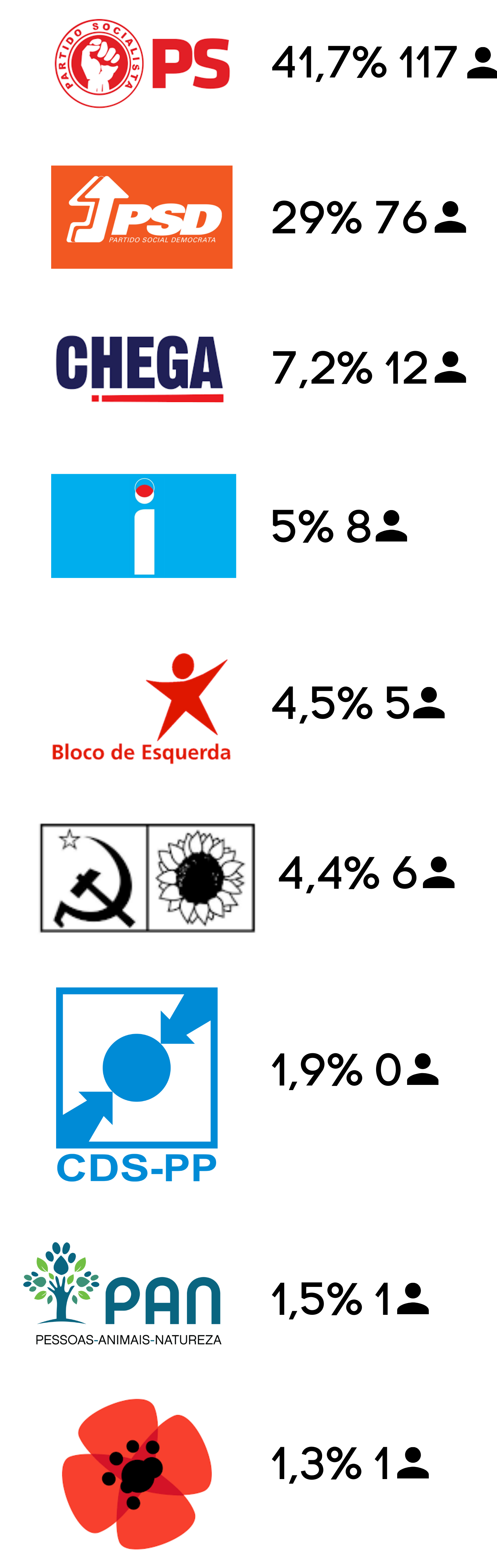
The center-left Socialist Party (PS) won 117 seats, one seat above the necessary to win a majority.
The center-right Social Democratic Party (PSD), led by Rui Rio loses 1 seat. In the polls, PSD and PS were incredibly close so this is a surprise.
The far-right Enough (Chega) becomes the third-largest political party in Portugal. In 2019, only the leader, Andre Ventura was elected into the assembly. This has now increased to 12.
The Liberal Initiative (IL) a center-right liberal party increases its seats from 1 in 2019 to 8 and becomes the fourth-largest party in Portugal.
The Left Bloco (BE) suffers a major loss. From 19 seats in 2019 to 5. Arguably, leftist voters are punished BE for voting against the state budget.
Similarly, the Unitary Democratic Coalition (CDU), a coalition between the Portuguese Communist Party (PC) and The Greens, lost half of their seats, from 12 in 2019 to 6.
CDS-PP, a center-right party with a conservative ideology loses all of its 5 seats. The party’s president Francisco Rodrigues dos Santos aka “Chicão”, quits.
PAN, a center-left ecological party loses 3 seats.
FREE (Livre) elects its left-wing leader Rui Tavares to the assembly, the main goal of the party’s campaign.
⬇️Do you think this will change the results of the Portuguese election? Let us know in the comments below ⬇️
On Sunday, January 30 2022, Portugal held an early general election to elect 230 members to the Assembly of the Republic. The Socialist Party won a majority with 117 seats in the assembly, winning 9 more seats than in the last election. This means that Antonio Costa, the leader of the Socialist Party will remain as Prime Minister. Around 48% of those eligible to vote went to the polls on Sunday, as well as a week before, a large improvement in comparison to recent years. Those in isolation or infected with COVID-19 were also allowed to vote from 6 to 7 PM on Sunday.
Why was an early election called in Portugal?
On October 27 2021, the state budget for 2022 proposed by the Socialist minority government was rejected in the assembly, as all other parties voted against it, even left-wing ones such as the Left Block (BE) and the Communist Party (PCP). The left felt like the state budget plan was too moderate and did not go far enough to tackle inequality and protect workers’ rights. In contrast, right-wing parties such as the Social Democratic Party (PSD) and the Liberal Initiative (IL) felt like the plan would not alleviate the tax burden on individuals and corporations and that there should not be an increase in investment in public services. In turn, in November of 2021, the President of the Republic, Marcelo Rebelo de Sousa announced snap elections set for January due to the collapse in the governing center-left/left alliance.
2022 Portuguese General Election Results
The center-left Socialist Party (PS) won 117 seats, one seat above the necessary to win a majority.
The center-right Social Democratic Party (PSD), led by Rui Rio loses 1 seat. In the polls, PSD and PS were incredibly close so this is a surprise.
The far-right Enough (Chega) becomes the third-largest political party in Portugal. In 2019, only the leader, Andre Ventura was elected into the assembly. This has now increased to 12.
The Liberal Initiative (IL) a center-right liberal party increases its seats from 1 in 2019 to 8 and becomes the fourth-largest party in Portugal.
The Left Bloco (BE) suffers a major loss. From 19 seats in 2019 to 5. Arguably, leftist voters are punished BE for voting against the state budget.
Similarly, the Unitary Democratic Coalition (CDU), a coalition between the Portuguese Communist Party (PC) and The Greens, lost half of their seats, from 12 in 2019 to 6.
CDS-PP, a center-right party with a conservative ideology loses all of its 5 seats. The party’s president Francisco Rodrigues dos Santos aka “Chicão”, quits.
PAN, a center-left ecological party loses 3 seats.
FREE (Livre) elects its left-wing leader Rui Tavares to the assembly, the main goal of the party’s campaign.
What does the Socialist Party forming a majority government mean for Portugal?
Since the Socialist Party (PS) won a majority, President Marcelo Rebelo de Sousa will soon ask Prime Minister Antonio Costa to form a majority government. PS will not need to form a coalition with other parties in parliament to do so. If PS had not won a majority, it would be close to impossible to pass their proposed state budget since all other parties were against it. Now, with a majority, the same state budget that was once rejected is likely to pass in the Spring.
However, Prime Minister Antonio Costa has stated that despite this victory, “An absolute majority doesn’t mean absolute power. It doesn’t mean to govern alone. It’s an increased responsibility and it means to govern with and for all Portuguese”.
The state budget or Orçamento do Estado in Portuguese that was proposed by the Socialist minority government and rejected is essentially the government’s budget for the year. PS states that their state budget is directed at uplifting the middle-class and young people. They want to invest further in public services such as the National Healthcare Service (SNS) and education, as well as increase the minimum salary, combat climate change, and tackle inequality. The state budget is hundreds of pages long but here are some highlights.
Young People
IRS Jovem (Income Tax for Young People), tax relief for young people starting their careers for 5 years, will now include freelance/self-employment. Those between 18 and 26 (or 28 if they have a doctorate) with at least a Bachelor’s will not have to pay either 30%, 20%, or 10% of their income tax for the first 5 years.
Programa Regressar (Program Return), for the next 4 years at least, this program allows those who have emigrated, particularly young people who are qualified to come back to Portugal until 2023 to get a tax relief of 50% on their IRS for 5 years.
Program to help young people find affordable housing.
Families
To fight child poverty, a financial program for kids. Until 2023:
For every child until 17 years of age, parents will receive €600 a year or €50 a month, be it through tax deduction or allowance.
In the case of families in extreme poverty, for every child until 17 years of age, parents will receive €1,200+ a year or €100 a month.
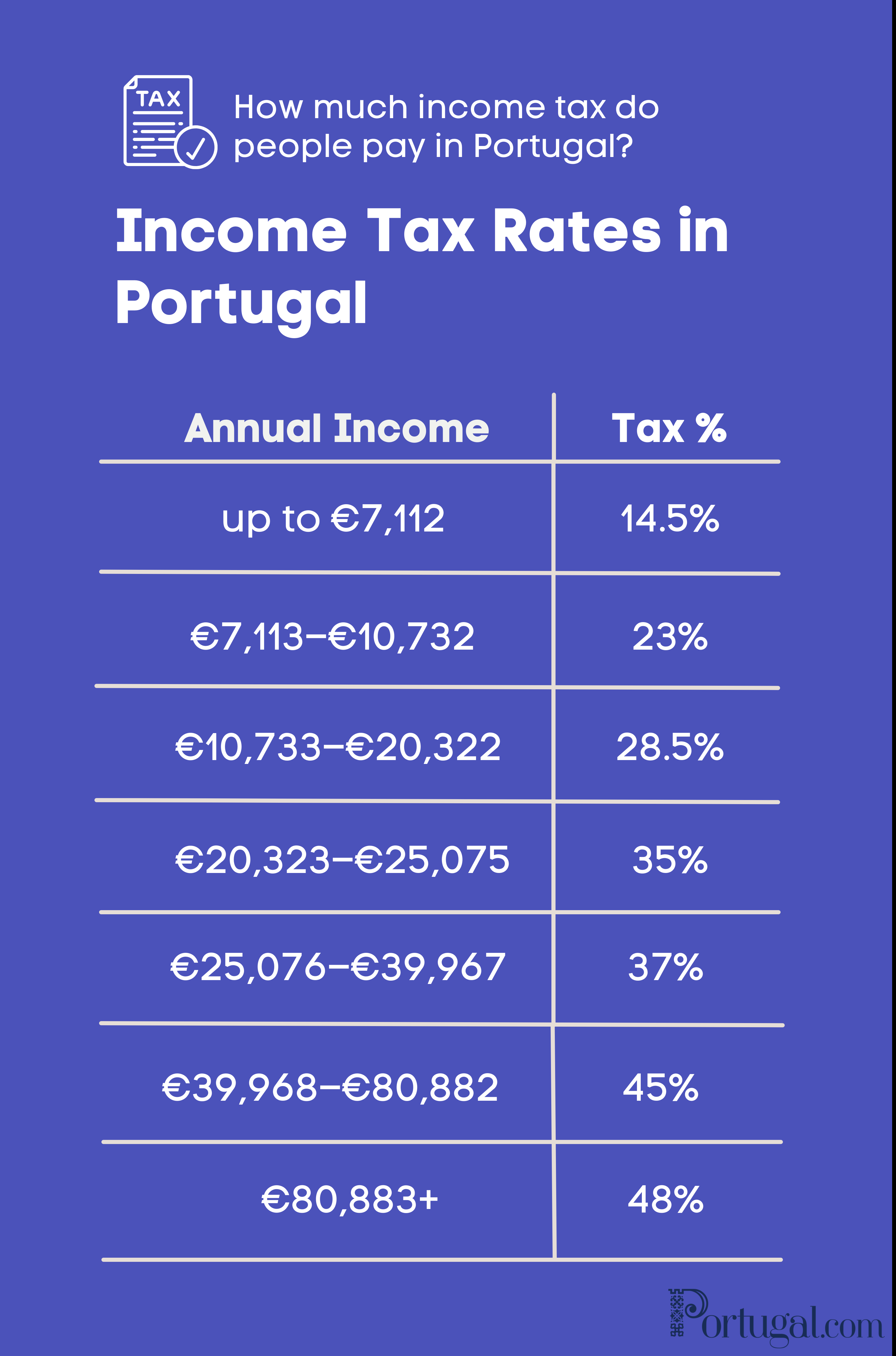
Free nurseries for kids in families that correspond to the first and second tax brackets in regard to household income (until around €10,700).
Allowances for informal careers all over the country.
Workers
The minimum salary should rise at the average that it has been increasing in the last few years, reaching €750 in 2023 (€702 in 2022).
The unemployment allowance should be a minimum of €500 for full-time workers.
Companies
There will not be an increase in tax for companies.
A fund of over 1 million euros will help those affected by the pandemic and a fund of over 100 million euros to support innovative companies.
Why did the Socialist Party win a majority?
The Socialist Party’s landslide victory came as a surprise to many and theories by commentators on why such a result occurred are circulating the media. The consensus is that voters on the left made use of the voto util (strategic vote) to make sure that a right-wing majority would not happen. The polls prior to the election showed a tight race between the center-right Social Democratic Party and the Socialist Party, as well as an increase in the popularity of Enough (Chega). Although many right-wing parties had stated they would not form a coalition with the far-right party Enough (Chega), others did not give a concrete answer. The left has been increasingly worried about the rise of such a party that goes against anti-fascist and democratic values.
Others on the left have chosen to vote for the Socialist Party to punish the Left Bloc (BE) and the Unitary Democratic Coalition (CDU) for voting against the state budget. These left-wing parties felt that the state budget did not tackle class inequality effectively and that the proposal was too moderate. Although many voters on the left would agree, many argue they are the responsible ones for the political crisis that led to the general election. The Socialist Party had also reminded the left that the state budget was the most left-wing one ever proposed in the history of Portuguese democracy.
However, it is also true that this election had one of the lowest abstention rates in the last few years. Many on the left went out to vote not only out of fear of a stronger right-wing movement but to show their approval of the Socialist Party. The Socialist Party has arguably successfully handled the Covid-19 pandemic which could have added to its success in this general election. For many, a vote for the Socialist Party signifies a vote for stability.
Photo by Element5 Digital (Unsplash)
Impact of Portuguese Election Results for Expats and Internationals
Although not hugely, a PS majority government could impact expats and internationals. Many on the left in Portugal (mostly BE and CDU) have been widely critical of the Portugal Golden Visa and the non-habitual tax regime for foreigners, arguing these provide tax relief to those that are already economically advantaged. The Golden Visa, for example, has also led to an increase in the property market at values much higher than the reality, making it almost impossible for the average Portuguese person to buy a house. We do not know for sure if PS winning a majority will mean a stronger stance against this.
What we know is that the changes to the Portugal Golden Visa have already been established, primarily motivated by the Socialist Party, as well as the Left Block. Since January 2021, those looking to be eligible for a Portugal Golden Visa can no longer purchase property in Lisbon and Porto, only some parts of the interior of the country. Although the state budget for 2022 does not mention the Golden Visa, it is still possible that more restrictions or a total ban could occur. However, this is unlikely to happen in the next year(s). The Left Bloc, for example, are seeking a complete ban of the Portugal Golden Visa as they felt the tax relief and easy path to citizenship was unjust and classist, as well as a ban on NHR status. The party has lost 14 seats in the assembly, leaving them with only 5 so they are unlikely to have much say on the matter now.
Despite this, the program of the Socialist Party has a few other points that could impact those coming from abroad. The party believes that immigration is necessary to sustain the development of both the Portuguese economy and the positive change in demographics. The party states they want to continue with progressive immigration policies that reflect their values of tolerance and openness. One specific policy is to reform SEF, the Portuguese Foreigners and Borders Service so that it does not act as a law enforcement institution, but rather one of an administrative function.
The party also wants to create a digital platform for immigrants to reduce the bureaucracy that Portuguese administrative functions are known for. This platform would make applying for a visa and uploading documents easier. PS also wants to simplify the types of visas out there and the complicated processes for each one, so that the overall immigration process runs more smoothly.
Moreover, the Socialist Party wants to attract international workers and talent. The party wants to start a program called StartUP Visa where foreign workers who want to develop an innovative project in Portugal can do so while living in the country.
The 8 Parties in the Portuguese Assembly of the Republic
1. Socialist Party (PS)
Social democracy, center-left – 117 seats
The Socialist Party was formed in 1973, a year before the Carnation Revolution. PS has won a majority of seats in the Assembly of the Republic on January 30, 2022. The party is a center-left party with social democracy, pro-European and progressive ideologies. PS wants to strengthen the national health service and tackle class inequality. The current Secretary-General of the United Nations, António Guterres was once the leader of the Socialist Party in Portugal.
2. Social Democratic Party (PSD)
Liberal conservatism, center-right – 76 seats
The Social Democratic Party was founded in 1974 and is a center-right party with both conservative and liberal economic ideologies. It is the second-largest party after PS. The party is led by Rui Rio and they campaign to reduce taxes.
3. ENOUGH (CHEGA)
Right-wing populism & national conservatism, Far-right – 12 seats
A far-right and nationalist party, ENOUGH was founded in 2019 by the leader Andre Ventura. This party believes that people living off social benefits are “leeches” of the state who do not want to work. They campaign for life imprisonment (which is not legal in Portugal), as well as chemical castration for child abusers. The party has been accused of racism, misogyny, and homophobia.
4. Liberal Initiative (IL)
Classical liberalism, center-right to right-wing – 8 seats
The Liberal Initiative was founded in 2017 and is the first liberal party in Portugal. Led by João Cotrim Figueiredo, the party focuses on the individual rather than the collective. IL campaigns for right-wing economics such as reducing taxes and promoting a flat income tax for all, as well as less “dependence” on social welfare. The party is unlike other right-wing parties as they are in favor of euthanasia, abortion, and gay rights.
5. Left Bloc (BE)
Democratic socialism, left-wing to far-left – 5 seats
Led by Catarina Martins, the Left Bloc is a feminist, ecosocialist, and anti-racist party that from 2019 until 2022 functioned as an opposition force. BE wants to allow immigrants and residents in Portugal to vote in parliamentary elections, reduce transport prices, as well as fight job insecurity and raise the minimum wage.
6. Unitary Democratic Coalition (CDU)
Marxism-Leninism & Eco-socialism, left-wing to far-left – 6 seats
Led by Jeronimo de Sousa, CDU is a coalition made between The Greens, an ecosocialist party and the Portuguese Communist Party. These two parties always run in elections together. They follow a Marxist-Leninist, communist, and anti-fascist ideology. CDU campaigned to invest in the national health service by increasing the number of medical professionals. They also want to reduce the working week from 40 to 35 days and want free education and public transport for all.
PAN was founded in 2009 and became known for fighting for animal rights, as well as environmental justice. The party holds ecofeminist, animalist, and progressive ideologies. PAN campaigned to invest in the national health service but does believe that the private and public sectors can work together. PAN also believes in free transportation to combat climate change.
8. FREE (LIVRE)
Eco-socialism & pro-Europeanism, center-left to left-wing – 1 seat
FREE, also known as Livre, was founded in 2014 by Rui Tavares. FREE’s ideology is ecosocialist, pro-European, feminist, anti-racist, and progressive. The party became known for supporting a trial of the Universal Basic Income, where every citizen would receive a sum of money to eradicate poverty. The party’s program also included increasing the minimum wage to €1,000, legalizing cannabis, investing in public health, and starting a Portuguese Green New Deal.
Take a look at our article on the Portuguese Political System to find out about the democratic process in Portugal.
Imagine yourself time traveling July 4, 1776, to Independence Hall, in Pennsylvania. The Second Continental Congress ends with the signing of the United States’ Declaration of Independence. Thomas Jefferson takes out a bottle and proposes a toast to this new nation, and the other Founding Fathers agree!
You get your glass and they fill it with this amber-colored liquor and you toast with them “To America!” You take a sip and that taste fills your mouth… It’s a strong drink, slightly sweet, with a hint of burnt caramel and the texture is so smooth!
Well, that was Madeira wine, and by the description it seems like a Medium-Sweet one. It was indeed used by the Founding Fathers to toast after the signing of the Declaration (although I admit we don’t know if it was indeed a Medium-Sweet) and it has been present in important moments throughout history.
Drinking a glass of Madeira wine is, as Winston Churchill once said, “drinking liquid history.”
What is Madeira Wine?
The Madeira wine is a fortified wine made on the Portuguese Madeira Island, right off the coast of Africa. Mainly produced in the Câmara de Lobos, its grapes have to be planted on the Madeira Island since this corresponds to the area of the Demarcated Region of the Madeira Island and the wine is a DOC (‘Denominação de Origem Controlada’ or ‘Controlled Origin Denomination’).
Madeira is a robust and long-lasting wine with a high alcohol content, since it’s made with a distilled grape spirit, being around 17-20% alcohol content. It’s made in different styles, from dry, used as an aperitif, to sweet, used as a digestif, depending on the amount of sugar it has (anywhere from 0-150 g/liter).
You can also find versions of this wine made for cooking, with added salt and pepper, but not fit to use as a drink. It’s used in the French classic ‘Madeira sauce’, used in dishes like roast beef or filet mignon, or in The Cheesecake Factory on its ‘Chicken Madeira’ dish.
Madeira is also said to have some health benefits, if you obviously use it in moderation and take care of its fattening characteristics (due to excess sugar, although this is less problematic with dryer wines).
It’s a similar wine to Port wine, produced on the Douro region, but the difference is in its unique storage and aging process, and it has its own type of glassware that helps savor the wine better.
This is the main product of the Madeira Autonomous Region and a symbol of the archipelago all around the world. Around 4 million Liters of Madeira wine are exported every year. In 1999, this represented around 43% of all the archipelago’s exports.
Other wines are made to mimic the Madeira wine, like in Crimea, California and Texas, and some even use the name “Madeira” or “Madera”. However, according to EU regulations, the use of these terms is only permitted to the wines coming from the Madeira Islands.
Honestly, as the Madeiran producers say, the other wines can never mimic theirs since the secret is in the excellent quality grapes; the barrels in which they’re aged in, made out of local wood; and the taste of the Madeiran sea.
History of Madeira Wine
When the island was colonized, in 1419, the first grapes immediately started to be planted. These came from Crete, in Greece, on the order of Infante D. Henrique. Then, more grape types came and started to be planted en masse.
It was on the 16th century that the wine industry started to become well-established on the island. At the time, the island was one of the main stops on the voyage from Europe to the New World or India, and vice-versa. This meant a lot of visitors and a lot of trade.
However, at the time, the wine made on Madeira Island was unfortified and only consumed by the locals and the visiting sailors. It couldn’t be transported and sold since it would quickly go bad after the trip.
This changed when stories of the English merchants discovering Port wine came to the island. Fortifying the wine with a spirit meant that it could be transported and sold to outside of Madeira without spoiling! When this became the common practice, the stopping ships would purchase the wine for both their crew and to trade it on their destinations.
The English loved this new wine and, being one of the biggest visitors and having the benefit of low taxes with Portugal due to the 1703 Methuen Treaty, started to buy it and made it famous wherever their ships went. The Dutch East India Company was also a huge buyer, ordering 470 liters of Madeira for their Indian trips.
This way, the wine became known all over Europe and America, becoming the preferred wine to have in banquets, at the tables of the European kings and the American leaders, as we’ve seen.
The wine is mentioned in many English books, showing the importance it had to English culture. For example, in Shakespeare’s ‘Henry IV’, Falstaff is accused of trading his soul for a chicken leg and a glass of Madeira wine. Another story (this one not in a book), is of the death sentence of George of York, Duke of Clarence and brother of King Edward IV. When asked to choose his execution method, he said he wished to be drowned in a barrel of Malvasia Madeira wine.
After the 18th century, the wine started to become Madeira’s main export, since the production of sugar was mainly transferred to Brazil. At this time, ships would go to the island specifically to buy the wine, giving the island a huge economic boost.
It was also around this time that the producers started to notice something: whenever the ships would return with extra shipments of wine that didn’t get sold, the wine would get better! They understood that this was due to the hot cargo holds during the long sea trips to warmer climates, once this didn’t happen to the ships that came back from colder climates. All of these conditions contributed to better the ageing process. The producers then started to make “vinho da roda” (or “wheel wine”), since it was specifically made to go around the world (like a wheel) on voyages and get better on the warm climates.
However, soon they understood that the costs of shipping the wine out and back was too much compared to the profit, so they began to heat the wine to mimic this process on the island, through the “estufagem” or “canteiro” methods.
The wine trade then went through several periods of crisis. First, in the 19th century, vine diseases hit the island and destroyed the vineyards. This was solved by using hybrid vines from America, which would then create another problem.
Then, there was the construction of the Suez Canal, which made the passage through Madeira avoidable in the trip from Europe to Asia, making the island lose a lot of their trade with India.
The First World War also brought hardships to the wine trade, since Madeira was vulnerable to German attacks, and then the Prohibition, in the USA, was announced, which damaged the business as well. After this was repealed, coal ships became the norm and made the stop in Madeira unnecessary since they could travel directly from Europe to America. During this time, Madeira became known as the “Forgotten Island”.
Finally, there was a problem with lack of quality, with the introduction of the greenhouse and the hybrids, and the wine became best known as cooking wine. Most of the vineyards started to close and its fields became tourist attractions or used to plant other things.
In 1989, thanks to Bartholomew Broadbent, the wine saw its rebirth, with new investments on the wine and a renewed American interest on Madeira wine. The winegrowers started to focus on improving the wines quality. They banned the hybrid and American grapes and replacing them by the better, old grape types and focused on implementing modern wine cultivation methods.
Nowadays, it has regained its credibility and prestige in the international markets.
How is Madeira Wine Made?
Photo by Jonathan Borba on Unsplash
Madeira is, as we’ve mentioned, a fortified wine. This is done with a neutral grape spirit, which halts fermentation and leaves residual sugar. The quantity of sugar will depend on the style of Madeira you are drinking.
This is similar to the Port wine production. One of the differences, at least in the beginning, was that Madeira was fortified with a very traditional Madeiran product: sugar cane spirit. Nowadays, this is no longer the case, however. Also, Madeira has to be stored and aged in warm places, while Port is in cool temperatures. This gives it a much stronger taste.
There is also a specific element to Madeira wine, which is strange for any other wine production: the producers deliberately put the wine in reaction with heat and oxygen (which usually make other wines go bad). One way to do this is through the “estufagem”, done in a large, usually stainless steel container where they heat the wine for 3-4 months. Another way is the “canteiro”, where the wine is left in casks, usually oak, on the attic where they get the suns heat. This lasts at least 4 years. This is to mimic the long sea voyages that the wine was subject to.
Grape Varieties and Style of Madeira
Photo by Filipe Gomes on Unsplash
The Madeira wine can be done with several types of grape, but red grapes are most of the production, even though white grapes are also common. However, the grape color isn’t what particularly gives it its color, as this wine gains an amber of toffee-like color when it goes through its heating and oxidation process.
The Tinta Negra grapes (literally, ‘Black Paint’) are the most used, representing around 90% of the total production. The other 10% are made with Sercial, Verdelho, Boal and Malvasia grapes. These are used for more fine wines, aged naturally in cask without using a greenhouse and then sold at higher prices.
The level of sweetness and the flavor of the wines is based on the grapes with which it was made out of. This way it can be:
Dry: as the name says, it’s a dry wine. It’s the freshest and crispest-tasting Madeira wine. An example of grapes used for this wine are Sercial.
Medium-Dry: a smoky and slightly spicy taste. Some compare it to caramel. Verdelho is a grape example.
Medium-Sweet: as imagined, is slightly sweet but with added flavors of coffee, cacao, burnt caramel and raisins. Boal grapes are used for this.
Sweet: the sweetest of them all with a rich note of chocolate, produced using grapes like Malvasia.
Tinta Negra Mole grapes can be used to make all varieties of Madeira. You can know what level of sweetness you’re buying by reading the label. As for the other grape types, they have to correspond to the wine content, being single varietal types.
Suggestions
If you are looking for a good brand, which you can trust will give you a faithful taste of what a good Madeira is like, these are some of the ones you should be looking out for:
You will explore the amazing vineyards of Câmara de Lobos, Porto Moniz and São Vicente, with tours through the cellars and the wineries, as well as wine tastings and amazing views of the vineyards, the forests and the Madeiran coat. You will also enjoy a traditional Madeiran lunch at a local restaurant with local wines.
Here you will explore both the amazing nature and the incredible wine that the island has to offer. Going from the island’s capital, Funchal, you will visit lots of incredible natural places, including Cabo Girão, the highest cliff in Europe and the second highest in the world! Then you will visit a very important wine producer and get a guided tour though the vineyards, as well as a wine tasting of their wine while learning all about the wine culture and production of the island. All of this while travelling between places on an open-top 4×4.
Go to the main place of wine production, Câmara de Lobos, to meet a local producer and learn about how this wine is made. Then tour the rest of the wine regions of the island and get the spectacular views of the Madeiran nature and vineyards, while tasting this fortified wine.
Portugal is known for its 300+ days of sun and its warm temperatures. Tourists (and even locals) never associate Portugal with snowy weather or a ski getaway. However, it does snow in Portugal, particularly in a mountain range called Serra da Estrela, where the Portuguese go skiing. Serra da Estrela is the highest mountain range in all of continental Portugal and is 100 kilometres long and 30 kilometres wide.
Serra da Estrela Natural Park is a great place to ski, particularly for beginners. Tourists and locals head to the ski resorts in Seia and Manteigas to enjoy the slopes. The best time to visit Serra da Estrela for skiing is between January and March, making February the best month. Since the mountain is located between the municipalities of Seia, Manteigas, Gouveia, Guarda, and Covilha, these areas are also wonderful to explore, even in the summer months.
If you’re looking to visit Serra da Estrela, we have got you covered with a Serra da Estrela travel guide. From activities to do, restaurants to try and the best hotels in Serra da Estrela, everything you need to know is right here.
Things to do in Serra de Estrela
1. Snow Sports: Skiing & Snowboarding
The only place to ski in Portugal is Serra da Estrela. This is also one of the only places in the country where it snows. You should visit the only ski resort in the country that is open from November to April. This small ski resort only has four ski lifts and is perfect for children, as well as beginners. There are around 130 meters of vertical descents and nine ski descents. The best time to ski and snowboard in Serra da Estrela is between January and March.
Photo by Ricardo Rocha (Unsplash)
2. Take a hike
Serra da Estrela has some of the best hiking spots in the country. From easy to harder trails, you’ll find hikes for every age group. You can find a list of trails, their altitudes, and kilometres here. You can also climb the “Torre” mountain (tower) that is 2000 meters high. On a clear day, you can see the Atlantic ocean more than 150 kilometres away. Another great hike is hiking from Manteigas to the Poço do Inferno, a 7.5 KM hike that is considered medium level. The village of Manteigas is a quaint town that is perfect to explore and a great spot to discover the local cuisine. The hike will lead you to a waterfall that offers beautiful views.
Photo by Francisco T Santos (Unsplash)
3. Discover the Cheese Culture
The Cheese of Serra da Estrela is well-known all over the world. The recipe for this cheese was first created in the 16th century and reflects the shepherd and mountain life. Discover iconic mountain flavours by pairing it with rye bread and local wine. You can also visit the Cheese Museum in Pêraboa where you’ll get to learn about the history of cheese making in the area. You will also learn a bit about the shepherds who have lived in the mountains for centuries and of course, sample the local cheese.
For a full experience, book this tour of Serra da Estrela that includes a cheese tasting.
4. Visit the Covão dos Conchos
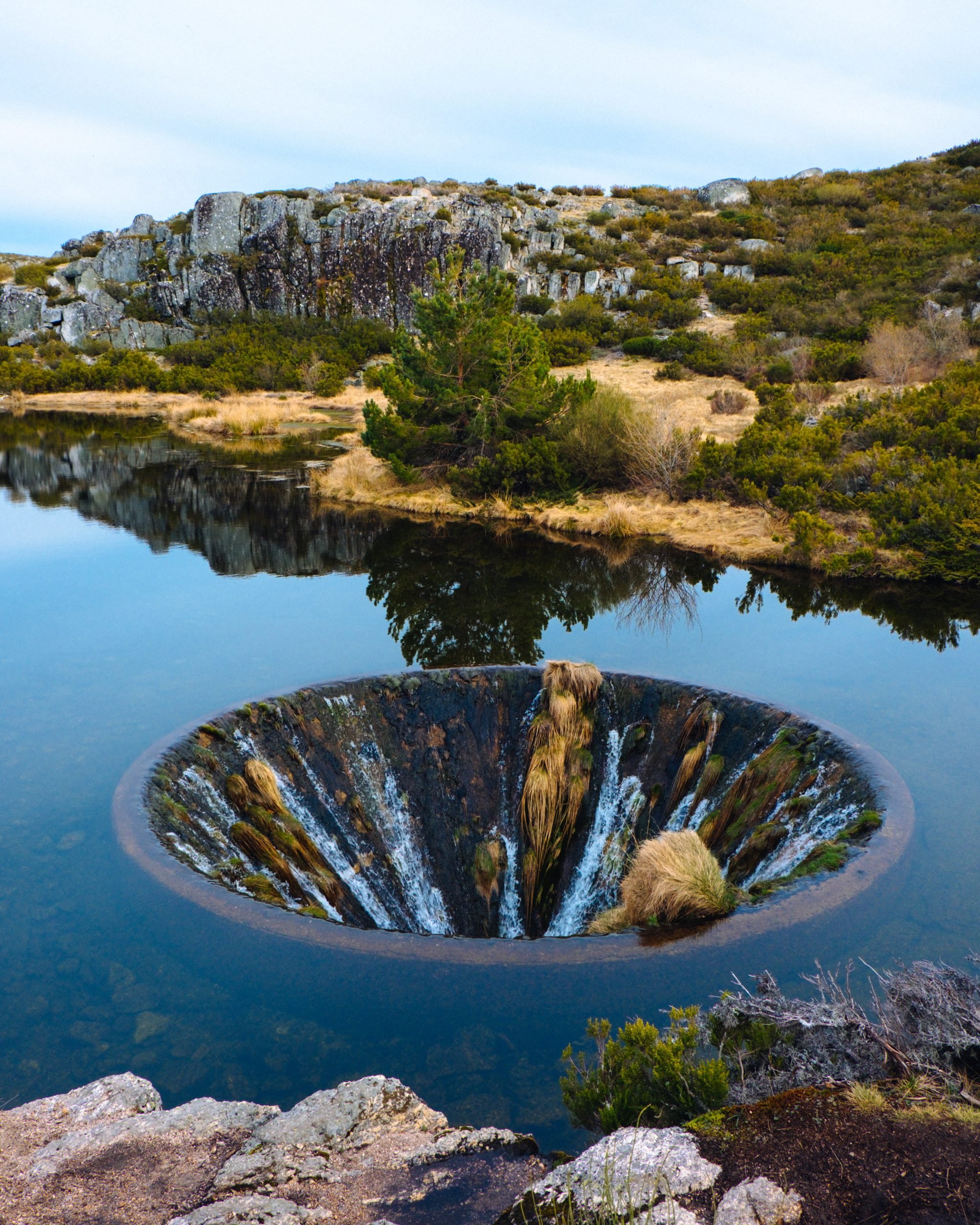
Covão dos Conchos, an artificial lake in the mountains is famous for its spillway, built in 1955 to divert water from Ribeira das Naves to Lagoa Comprida. This spillway actually went viral in 2016 for its sci-fi presentation. Over the last decades, moss has grown on top of it, adding to its beauty. The tunnel that collects the water to diver it is around 1,500 meters long. You can take a hike to get there, although this hike is difficult during the winter.
Photo by Natanael Vieira (Unsplash)
5. Explore the villages of Piódão
Piódão is a parish of multiple villages that take you back in time. These are often referred to as the historical villages of Portugal. Surrounded by forest and mountainous terrain, these tiny villages remind you of the set of Game of Thrones. You’ll find some of the best restaurants in the country located in the stoned houses in narrow streets. The parish includes Piódão itself, Malhada Chã, Chãs d’Égua, Tojo, Fórnea, Foz d`Égua, Barreiros, Covita, Torno, Casal Cimeiro and Casal Fundeiro.
Book this tour for a full-day private tour of some of the villages.
Serra da Estrela Weather: What is the Weather Like in Serra da Estrela?
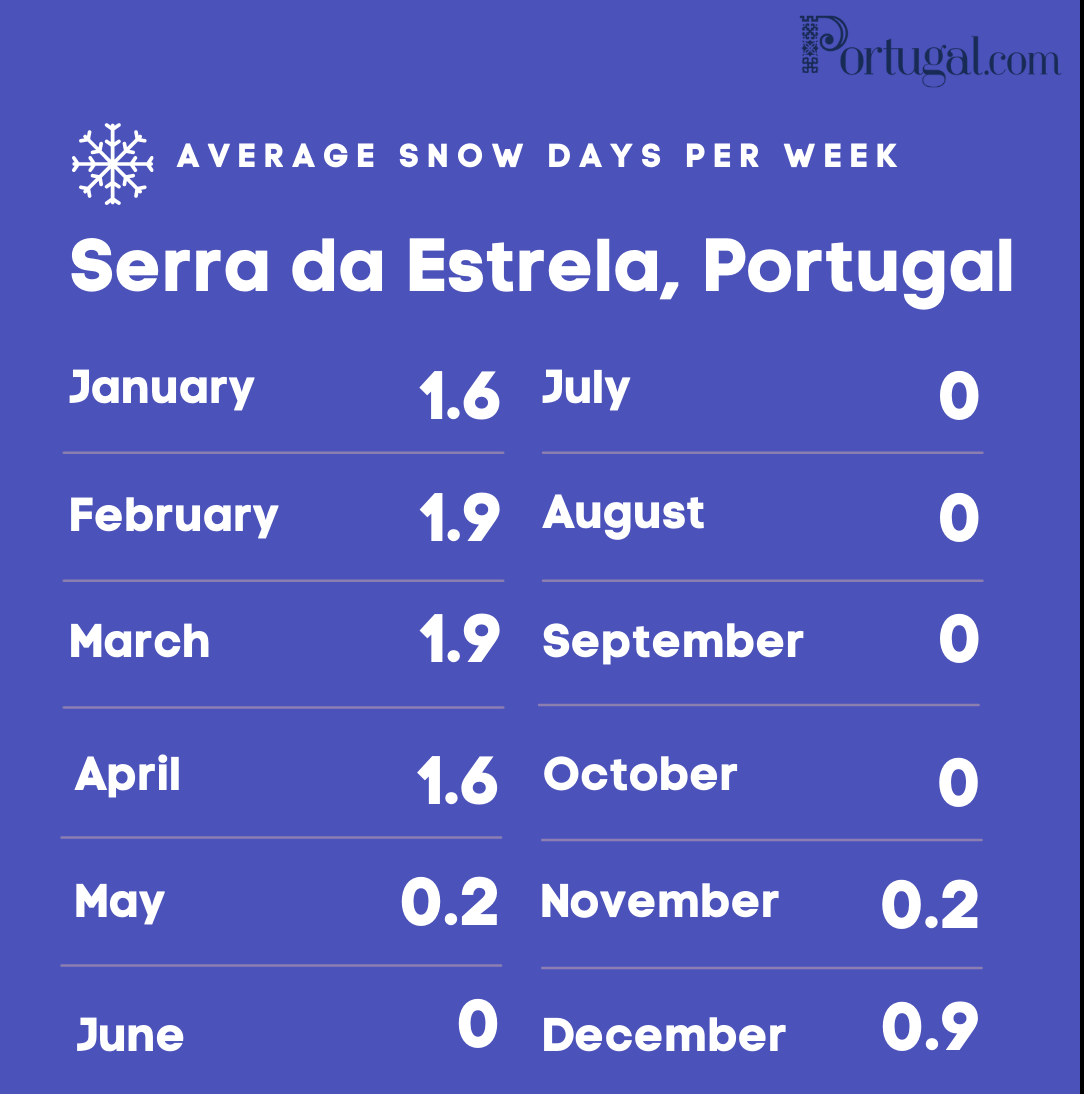
Snow in Serra da Estrela
Weather in Serra da Estrela by Season
Spring (March – May)
Spring in Serra da Estrela is moderately cold. Temperatures are usually around 8.6°C (47.4°F), the highest being 17.8°C (64.1°F). There are around 10 days of rain per month. This time is not as busy with tourism.
Summer (June – August)
Summer is quite a busy season in Serra da Estrela as it rains the least, at around 2 days per month. Temperatures usually range from 10°C (50°F) to 20°C (68°F).
Fall (September – November)
Fall in Serra da Estrela is quite mild with temperatures between 5.7°C (42.3°F) and 21.8°C (71.3°F). It can rain up to 10 days a month. Fall is when hotels are less busy.
Winter (December – February)
Winter in Serra da Estrela is cold as temperatures can reach around -5°C (23°F) to -10°C (9.4°F). Like fall, this is a very rainy season.
When is the best time to visit Serra da Estrela?
If you are going to ski or snowboard, the best times to visit Serra da Estrela are between January and March, making February the best month. If you are looking to hike and enjoy some warm weather, the best months to visit are July, August, and September. Regardless of the weather, Serra da Estrela is a beautiful experience all year round.
5 Best Restaurants in Serra da Estrela
Serra da Estrela is known for its unique cuisine and many well-known products in Portugal come from this region, including the Serra da Estrela cheese, the beef stew, and olive oil. The food here is like nowhere else in the country. You’ll find affordable prices that will satisfy your stomach on those cold days. Here are the 4 best restaurants in Serra da Estrela:
Located on the top of the “torre” mountain, this place offers a panoramic view of the mountain range. This restaurant serves regional dishes such as a shepherd style stew, as the Serra da Estrela Cheese. You can get a meal here for €20. Considering the view you get from this restaurant, it really is a bargain.
Varanda da Estrela is a small rustic restaurant on the top of the mountain. Perfect for a cold day, warm yourself next to the fireplace and try some of their delicious dishes. We recommend the “porco preto” (pig) and codfish. This place also has vegetarian options that feature the Serra da Estrela cheese. You can get a meal here for under €15.
This restaurant is so amazing that you have to book way in advance. This stoned restaurant specializes in traditional mountain food made with regional products. We recommend the leitao (roast pig) and the javali (wild boar), dishes you will not find anywhere else at this quality. A menu with starter, main, dessert, drink, and coffee costs €17.
Located in the Luna Hotel, having a meal at Restaurante Medieval offers a unique experience. Regional dishes are presented in medieval style with large wooden tables and a communal atmosphere with a buffet. The walls are made out of a typical stone and the wooden walls make you feel like you are going back centuries. We recommend trying their meat dishes and their selection of Serra da Estrela Cheese, the recipes dating back thousands of years. A meal here will cost you less than €20.
Lenda Viriato was founded to give guests an experience that takes them back to the origins of Portugal. Name after Viriato, the leader of the Lusitan people that represents victory and courage, this restaurant has a strong history. The building was built in 1905 and was where the local people from the village came to bake bread on a wooden fire. Today, you can try regional foods such as veal, pork, and boar dishes. You can have a meal here for less than €20.
Transportation in Serra da Estrela: How to Get to & Around Serra da Estrela
To get to Serra da Estrela from Lisbon, you can take a bus, train or rent a car. A train from Lisbon to Covilha is around 4 hours and costs around €30. From Covilha, you can take a 20 minute taxi for €15 to Serra da Estrela. You can also take a bus from Oriente Station in Lisbon to Covilha that takes 6 hours and costs €20. However, we do recommend renting. car so that you can get around Serra da Estrela more easily. The drive from Lisbon to Serra da Estrela is around 3h30 minutes. This is the best option as the bus system is quite slow and not the most convenient in the snow.
5 Best Hotels in Serra da Estrela: Where to stay in Serra da Estrela
Quinta do Rio Noémi is a 19th-century property, 3 km away from Guarda Castle and has an outdoor swimming pool, a garden, and a terrace. Each room is equipped with air conditioning and a flat screen. Some rooms have a private patio, perfect to enjoy an afternoon cocktail in. A sustainable property, you can get a room here for €90.
SerraVale – House & Nature, located near SkiPark Manteigas is the perfect accommodation for families wanting to go skiing. The property has a garden, a shared lounge, and a bar. The property has a rustic environment and each room has a different decor theme. All rooms have a flat-screen TV and a private bathroom. A room here costs at least €60 a night with a continental breakfast included.
Casa de Lagarinhos is a 400 m² private villa for 13 people, only 10 km away from the Serra da Estrela mountain. If you’re looking for a vacation getaway for the whole family, this place won’t disappoint. The 6-bedroom property has panoramic views, a garden, a jacuzzi, a spa, a sauna, a gym, and more. This place even has a large room with a pool table. You can rent the whole villa for only €300 a night.
Only 1 km away from the mountain, Turismo Rural Macieira Brava is located in Guarda. This picturesque one-bedroom home in a rural environment is surrounded by nature, offering a peaceful and secluded atmosphere. All windows on this property are double glazed for a warm interior. This place also has a garden and terrace. You can rent this home for €150 a night.
Lusitânia Hotel is a 4-star hotel with a dry and wet sauna, a hotel tub, and a massage room. Along with a gym, this hotel also has a gym and water sports facility, as well as an organic farm and flower garden. The hotel’s restaurant makes use of products from the organic farm. All the rooms have modern decor and satellite TV, as well as free wi-fi. You can rent a room here for €130 a night with breakfast included.
Frequently Asked Questions about Serra da Estrela
Can you ski in Serra da Estrela? Is Serra da Estrela good for skiing?
You can ski in Serra da Estrela. Serra da Estrela has a small ski resort with four ski lifts and nine ski descents, making it a good place for beginners and children.
Can you ski in Portugal?
You can ski in Serra da Estrela in Portugal.
Does it snow in Portugal?
It snows in Serra da Estrela, particularly between January and March.
How cold does it get in Serra da Estrela?
Winter in Serra da Estrela is cold as temperatures can reach around -5°C (23°F) to -10°C (9.4°F).
The city of Porto is beautiful and there are places that remind us of other times. Many hotels manage to preserve this antiquity and history, thanks to the classic and Renaissance decoration and furnishings, or even the building in which they are located. At the same time, there are hotels that seek to show the sophisticated side of the city, with modern architecture that matches the context and region where it is located. See below some examples of luxury hotels, both modern and more classic.
Sheraton Porto Hotel & Spa
Hotel Sheraton is one of the most beautiful and luxurious hotels in Porto. This hotel is located near Av. da Boavista, in a very central area and close to most of the city’s points of interest, such as Casa da Música. Among the hotel’s amenities are the spa, the indoor and outdoor pool, the yoga studio, the restaurant and the glass wine cellar. The spa has eight rooms available. The restaurant is called Porto Novo and features Portuguese cuisine.
The rooms are very spacious and elegant, decorated in wood, glass and steel. They feature a private bathroom where you will find a bidet, bath or shower, toiletries, bathrobe and hairdryer. The television has both satellite and pay-per-view channels. For fun at the hotel, there is also a room with snooker.
InterContinental Porto
The InterContinental Hotel is located in Palácio das Cardosas, a palace that dates back to the 18th century and has been completely renovated. In addition to large spaces and beautiful, classic decoration, the rooms have views of the historic city center. Torre dos Clérigos is just 200 meters from the hotel.
The hotel has a 24-hour gym and a spa with three rooms and a sauna. The Astoria restaurant serves typical Portuguese cuisine, but with a more contemporary twist. And the bar has a relaxing atmosphere and a full menu of wines and cocktails. The rooms have high ceilings, flat screen televisions, marble bathrooms with bathtub and shower stall. Many of the rooms also feature a small lounge area, with plush chairs (like the one pictured below). The access to Wi-Fi is free and throughout the hotel. The bathrooms in each room have a hairdryer, bathrobe, slippers and bath/shower. Pets are allowed, upon request and may have fees added to the room rate.
Hotel Pestana Freixo Palace
The Pestana Hotel is located in the Palácio do Freixo, in the Campanhã neighbourhood. This has the advantage of being is close to the beach, just 10-minute walk away. The palace is of 18th century baroque style. Its aristocratic public areas have remained, with beautiful and imposing architecture. The pool is large, with infinity edge and facing the river, and has several sun loungers around where guests can relax. There is also a poolside bar, where you can enjoy a few drinks throughout the day. At the spa there is a Turkish bath, massage at an additional cost, sauna and other aesthetic services. There is also a fitness center, for those who want to exercise during their trip. The hotel’s restaurant, Pousada do Porto, serves a buffet breakfast.
The rooms are modern, spacious and feature a separate seating area, flat-screen TV, air conditioning and bathrooms with luxury amenities and a hairdryer. All the rooms have beautiful views, but some have the privilege of overlooking the Douro River. The private bathrooms have a hairdryer, bathrobe and other items that only a luxury hotel could offer. The Wi-Fi is free and is available in all areas of the hotel, including the rooms. Parking is public and free of charge. Please keep in mind that pets are not allowed.
Hotel Infante de Sagres
The Hotel Infante de Sagres is another of the luxury hotels in Porto. It is located in the city centre and is a member of the Small Luxury Hotels of the World. Located just 4 minutes walk from the Aliados metro station, it is a great option for those who want to have everything close by and don’t want to miss a good hotel full of comfort and top services.
Take advantage of the proximity and visit Casa da Música, which is less than 10 minutes by car from the hotel. The hotel restaurant is inside a bookshop, called Restaurant Book for this reason, which guarantees an intimate and almost unique atmosphere. The restaurant has refined dishes and several Douro wines. You will also find several famous restaurants and gastronomic options just a short walk from the hotel. The Galeries de Paris, a trendy area filled with famous bars, shops and restaurants, is 200 meters away.
The rooms are beautifully decorated and refined, with neo-baroque style furnishings, antique chandeliers, flat screen TV with satellite channels, air-conditioning and super-complete bathrooms that are very organized and clean, offering toiletries, a hairdryer and other details. The rooms also have air conditioning. The Wi-Fi is free and works throughout the hotel.
Hotel Cristal Porto
The Hotel Cristal is one of the most recent luxury hotels in Porto. It has a 4 star rating, the lowest of the others mentioned, but has an incredible and very modern decoration. It is located in the city center, next to the Lapa Church and Avenida dos Aliados. This hotel has no swimming pool, but a beautiful garden where guests can relax, with several tables and chairs. The restaurant is buffet style and there is also a bar, with beautiful port wine titles.
The rooms have a clean and modern decoration in blue and white tones. They have comfortable beds, linen and towels, wardrobes, flat-screen TV, safe, air conditioning, minibar and private bathroom. Some of the rooms have a beautiful bathtub, where you can relax and take a very nice bath. The wifi is free and is available throughout the hotel. There is a bicycle rental service (payable separately) and parking, which is also paid separately, costing €10 per day. Pets are not allowed. Its calm setting away from the hustle and bustle of the city also houses a buffet-style restaurant, as well as a bar where Port wine can be sampled and the breakfast is served from 07:30 to 10:30. Guests can leave their car at the 24-hour parking (at an extra cost). Cristal Porto Hotel is also a 5-minute walk from Faria Guimarães Metro Station and 2 km from São Bento Train Station. Porto International Airport is 14 km away.
Between Lisbon and New York lies an archipelago called the Azores, made up of 9 islands. The Azores are a part of Portugal and are located 850 miles west of what the Portuguese call the “mainland”. Millions from all around the globe travel to the Azores every year to discover the beautiful landscapes and unique cultural heritage of each island. While visiting every island would make the perfect long vacation, many online have time to visit a few. To figure out which one best fits your budget and taste, you need to learn a bit about what makes each island special. You are in luck, as we have a travel guide for every island of the Azores:
Corvo is the smallest island of the Azores and has less than 400 inhabitants. The most remote island of the archipelago, Corvo provides an isolated getaway with astonishing green landscapes, narrow streets with black stone, and sea views. Together with Flores, a few kilometers away, Corvo is considered a World Biosphere Reserve by UNESCO. The top activities in Corvo are bird watching, hiking, swimming in natural pools and beaches, as well as visiting the 300-meter deep volcanic crater.
This 67 square mile island is home to 15,000 locals and is the westernmost point of Europe. Faial is nicknamed the Blue Island because of the hydrangeas in different shades of blue that span the landscapes of the island. Located 4.5 miles from Pico and 11 miles from São Jorge,Faial is a cosmopolitan island that still features activities for nature lovers. From hiking the 400-meter deep volcanic crater, exploring the city center of Horta, and visiting the Capelinos, a volcano that erupted in 1958, this island has so much to offer.
Less than 4,000 people live on this island, making it a quaint destination to experience the Azorean way of life. The island’s name, Flores, translates to “flowers” because, during the summer, it is covered with thousands of blue and pink hydrangeas, as well as yellow goldenrods. These cover the sides of the roads that cross the green landscapes. Flores offers an astonishing landscape of green rolling hills and blue lakes, waterfalls, and sea views. Flores might not be the island that every tourist visits when traveling to the Azores, but this is also what makes it so special. Flores has some of the best natural pools in Santa Cruz das Flores and is known for the seven lakes, blue and green lakes that span the volcanic crater.
Graciosa, a UNESCO World Biosphere Reserve has a unique landscape and a strong architectural heritage that makes it a top Azorean island to discover. Graciosa is 12.5 KM in length and has around 4,000 inhabitants. Part of the Central Groups of the Azores Archipelago, its closest neighbor is São Jorge, making it a great spot for island hopping. The nickname for this island, the White Island, comes from the white characteristics of Graciosa seen in Pedras Brancas (White Stones) and Serra Branca (White Hills). Our favorite things to do in Graciosa are swimming in the iconic thermal baths and visiting the Caldeira da Graciosa, a large crater that is classified as a Regional Natural Monument.
The Hawaii of Portugal, Pico is home to Portugal’s highest mountain, Pico mount at over 2,000 meters high which you can hike. Pico is the most recently formed island of the Azores at only 300,000 years old. Pico island is 46 kilometers long and is filled with exotic vegetation and astonishing sea views. Pico is known as the Ilha Preta (“Black Island”) because of its black volcanic soils which nourish the UNESCO-designated vineyards. Pico island’s history has been built around its wine and whaling culture. Since whale hunting was made illegal in 1986, Pico has ever since been leading a movement of fair treatment study of whales, as well as other sea animals. It is one of the top places in the world for whale-watching, as well as hiking and wine tasting.
Santa Maria is one of the warmest and driest islands in the archipelago, as this island is the most southern of the Azores. The island of Santa Maria is the home of 6,000 Azoreans and is around 96.87 km². Along with São Miguel 81 KM away, Santa Maria is part of the Eastern Group of the Azores. Santa Maria is unique from the other islands, with yellow beaches and even a “red desert”. From exploring the town center Vila do Porto and swimming in some of the best natural pools in the Azores, Santa Maria is an island to not miss.
São Jorge is a volcanic island that features astonishing views of Pico and Faial island. The island is known for its beautiful contrasting views of a green landscape and dark blue ocean. Around 9,000 people live on the island that spans 243.9 sq. km. A part of the “triangle islands” with Faial and Pico, this island features fajãs that make up quaint villages and natural pools. We recommend visiting the coffee plantation, the only one in Europe, as well as the cheese factory.
São Miguel is the most famous island in the Azores and is the most populated island of the Azores with 140,000 inhabitants. 45,000 people reside in Ponta Delgada, the island’s largest city. The island is part of the Eastern Group of the Archipelago with the island of Santa Maria that is 80 kilometers away. From the São Miguel iconic pineapple plantations to the cozido das furnas, the island has a rich culture and Azorean cuisine. The island has so much to offer. From diving, hiking, surfing, and biking, São Miguel is great for the whole family
The name Terceira means “third”, as this island was the third to be discovered in the Azores in the 15th century. It is the second most inhabited island of the Azores, with around 60,000 people living there. The island’s beauty is a consequence of the contrast between the natural landscapes of the volcanic island and the human-built historic center. You must visit the capital of the island, Angra do Heroísmo. It was founded in 1534 and was the first place in the Azores to be classified as a city. It was made a World Heritage Site by UNESCO in 1983. There is so much to experience on this island, from water sports to visiting an extinct volcano called Algar do Carvão. Terceira island is nicknamed “the festive island” because it’s known for its local festivals that are full of life and represent Azorean culture. Visiting during these festivities is a great option.
Azores: When to Go & Weather
Average Temperature in the Azores by Month
Azores Weather in January
Average temperature 14.5°C (58.1°F)
High temperature 17°C (62°F)
Low temperature 12°C (54°F)
Rainfall days 17 days
Azores Weather in February
Average temperature 14°C (57.3°F)
High temperature 17°C (62°F)
Low temperature 12°C (54°F)
Rainfall days 17 days
Azores Weather in March
Average temperature 14.5°C (58.1°F)
High temperature 17°C (62°F)
Low temperature 12°C (54°F)
Rainfall days 15 days
Azores Weather in April
Average temperature 15°C (59°F)
High temperature 18°C (64°F)
Low temperature 12°C (54°F)
Rainfall days 12 days
Azores Weather in May
Average temperature 16.4°C (57.3°F)
High temperature 19°C (62°F)
Low temperature 14°C (54°F)
Rainfall days 10 days
Azores Weather in June
Average temperature 18.7°C (61.4°F)
High temperature 21°C (71°F)
Low temperature 16°C (60°F)
Rainfall days 9 days
Azores Weather in July
Average temperature 20.8°C (69.5°F)
High temperature 24°C (75°F)
Low temperature 18°C (64°F)
Rainfall days 8 days
Azores Weather in August
Average temperature 22.2°C (71.9°F)
High temperature 25°C (78°F)
Low temperature 19°C (66°F)
Rainfall days 10 days
Azores Weather in September
Average temperature 21.4°C (76°F)
High temperature 24°C (65°F)
Low temperature 18°C (66.6°F)
Rainfall days 13 days
Azores Weather in October
Average temperature 19.2°C (66.6°F)
High temperature 22°C (71°F)
Low temperature 16°C (62°F)
Rainfall days 14 days
Azores Weather in November
Average temperature 16.8°C (62.3°F)
High temperature 19°C (67°F)
Low temperature 14°C (58°F)
Rainfall days 15 days
Azores Weather in December
Average temperature 15.4°C (63.5°F)
High temperature 18°C (64°F)
Low temperature 13°C (55°F)
Rainfall days 18 days
The best times to travel to the Azores are between May and September. Temperatures are the most moderate at this time, rarely getting higher than 30ºC. During the winter, it usually doesn’t get colder than 7ºC. The Azores rarely get heat waves in summer or cold waves in winter so you can also travel all year long. However, it does rain a lot less between May and September, making it a better time to enjoy all of the outdoor activities that the Azores have to offer.
If you are looking for a five-star experience, SENSI is the place to go. This place has an astonishing view of the ocean and is decorated in a boho-chic style. SENSI features an indoor and outdoor pool, a garden, and a spa. Ponta Delgada is a 30-minute drive away, which is not uncommon on the island. A large room with a sea view costs around €120 a night.
This place feels like a tropical oasis. Azul Singular offers a sustainable tented experience. You will sleep in your own little wooden hut or yurt tent, in the middle of gorgeous palm trees. This is truly a one of a kind experience. Every unit comes with an equipped chicken, a dining table, and a gorgeous bathroom. You get a continental or vegetarian breakfast, brought to your unit every morning. A yurt tent costs €70 a night and a superior wooden tent costs €75 a night.
Cabanas da Viscondessa offers private wooden cabins with a view of the ocean and Pico Island. A luxurious experience, each cabin has been decorated in an elevated style by a renowned interior designer and a private terrace with a garden view. Each unit also comes with a modern kitchen, dining area, and bathroom. This property has a restaurant, bar, and a shared garden, as well as an outdoor terrace where you can enjoy a meal or drink. Every morning, a continental breakfast is served from local products. The studio cabins cost between €80 and €100 a night depending on the season.
The Shipyard is located in the historical center, a 10-minute walk from Praiana Beach, one of the best beaches on the island. This place has a restaurant called Oficina da Esquina, a high-end restaurant serving Portuguese food. The property consists of a series of modern studios and apartments, perfect for any kind of tourist, from solo travelers to families. A studio with breakfast included costs €70 and a one-bedroom apartment is €85. They also have larger apartments at a higher price.
Charming Blue is a modern hotel that has 15 rooms in Vila do Porto, Santa Maria. Each room is elegantly decorated and comes with a view of the sea or pool, a TV, and a luxurious bathroom. The hotel has a large pool for guests to enjoy as well as its own restaurant called Mesa d’Oito where you can enjoy delicious dishes. You can also enjoy a highly rated breakfast at this place. You can get large rooms here for €80 a night.
Casa da Barra, located in Santa Cruz da Graciosa is a large holiday hope surrounded by green landscapes. The three-bedroom home sleeps up to five people, has a living room and two bathrooms. The home has a large garden and a barbecue, great for a sunset dinner. You can also rent a car at the property to get around the island. This home costs €100 a night.
What better place to stay than your very own Azorean cottage? Built out of black lava rock, Adega do Xelica is only 5 minutes away from a wonderful natural pool. This place is in Arcos and features a terrace with a view of Mount Pico. It has 2 bedrooms, 1 bathroom, a balcony, private terraces, a dining area, as well as free private parking. All of this for only €100 a night.
Located in the quaint Lajes das Flores, Casa da Boa Onda is an entire home that you can rent. The property has 1 bedroom and 1 bathroom, as well as a kitchen and dining area. The best part of this place is that you can enjoy the view from the house’s terrace. You also have free parking in front of the house. This place can sleep up to 3 people as it also has an extra single bed if necessary. It’s also located near many hiking trails, perfect for a morning stroll. The whole house only costs €50 to €70 a night depending on the season.
Joe & Vera’s Vintage is a quaint guest house with cozy rooms that feature a private bathroom, a desk, and a patio. This place also offers a delicious continental breakfast at an affordable price. A 15-minute walk from Praia da Areia, this guesthouse also offers an airport shuttle service, as well as free parking. You can get a room here for €70.
Known for being the first European to reach India by sea and thus connecting, for the first time, Europe and Asia by maritime trade, Vasco da Gama, the 1st Count of Vidigueira, was a Portuguese explorer. His first voyage was the longest ocean travel in the world at the time and he was always briefly the Viceroy of India, before dying.
He is a controversial historical figure, with the explorer being known to have committed several atrocities and being a violent person, besides the consequences of his travels. Besides that, he is an unavoidable figure in History.
Early Life
Not much is known about Gama’s early life. He was born in the 1460s, he was the third son in a minor noble family. His father was a knight in charge of the Sines Fortress, in the Alentejo coast, and his mother was a noblewoman.
It is supposed that, due to his stature, he had a good education and, since he was living on the coast, he also probably learned about sea navigation.
By 15, he was familiar with the trading ships that were docked in the ports and by 20 he had already managed to become the captain of a ship. His career must have been very remarkable, since almost 20 years later, he would be sent to command one of the most historic voyages in the world.
The Historic Voyage
Photo by Bruno Martins on Unsplash
The well-known story starts in 1497. At the time the Muslims, especially the Ottoman Empire, held in their control the trade routes from the East, including India. This made all of Europe dependent on them since gold, spices and many other Eastern riches were well appreciated in all the continent, and they knew this so they charged high prices to the Europeans and for their ships to pass through their ports.
As a way to counterbalance this, the Portuguese king, King Manuel I, decided to send a fleet that would search for the maritime route to India and chose Vasco da Gama to lead it. This was to continue the work already started by Bartolomeu Dias, who was the first navigator to have rounded the Cape of Good Hope.
The explorer set sail in July with 4 ships from the port of Lisbon. Gama commanded the São Gabriel ship, Paulo da Gama, his brother, commanded the São Rafael, and there was also the caravel Berrio, and a storeship São Maria.
They travelled along the coast of Africa until he reached the South Atlantic, when they decided to adventure into the open sea, as a way to avoid unfavorable currents. When reaching the Southern part of Africa, in what is now Cape Town, the fleet passed through the Cape of Good Hope, probably the hardest part of the voyage as it had only been crossed one time before!
The navigator and his fleet continued to travel along the African coast, stopping in today’s Mozambique and Kenya for supplies, sicknesses and to ask for directions, even getting the help of an Arab navigator in one of their stops, that travelled with them and showed them the way to cross the Indian Ocean until they finally reached Calicut (now Kozhikode) in 1498.
Initially, the local Hindus welcomed the Portuguese, making them think they were Christians. But soon the mood soured when Gama’s gifts were considered cheap by the local ruler and the local Muslim traders understood the reason for their presence there and became hostile to the Portuguese. Gama thus had to leave without making a treaty with the locals.
This was a huge feat in world history. It is considered by many to be the root to today’s Globalization, as it initiated a global cultural, economic and historic connection as it had never existed before.
However, it also started the era of global imperialism and colonization, first with the full-blown conquest of territories by the Portuguese Empire and then by the other European powers. A conquest that would, with rare exceptions, encompass all parts of the world in one way or another, and would lead to awful creations and the subjugation of peoples.
In fact, Gama himself had the fame of being violent with the natives and of taking hostages, something that continued to happen with those that followed him. The tactic employed by the Portuguese was then adapted by the rest of the Europeans that set foot on the Indian subcontinent and throughout the world in their quest for lands to colonize.
Finally, two years after setting sail, in 1499, the fleet arrived home, with at least 54 out of the 170 men that made the fleet… Vasco da Gama’s own brother died on the road… But after 300 days spent at sea and 24,000 miles travelled, the surviving men were considered heroes and had made history, for better or for worse.
They had made the longest ocean travel until then and had just boosted the Portuguese economy immensely, since they now had the monopoly over the Indian spice routes. And with the known riches of the Orient came new ones, like spices such as pepper and cinnamon.
The King thus praised Gama’s success, and gave him huge sums of money and the title of admiral.
Second Voyage
Other expeditions had been sent to India before, but in 1502 Gama was asked to be a part of a second expedition, which he accepted.
This voyage had 10 ships and was much more hostile than Gama’s first one. When passing through Kilwa, in today’s Tanzania, the Portuguese threatened the leader and forced him and the population to swear loyalty to the king of Portugal, creating trading posts throughout the East African coast. Also, when he arrived at Calicut, they bombarded the port, killing many Muslim traders and forcing the Calicut’s ruler to reach a treaty, and in Cochin he fought with the Arabs, making them retreat.
The fleet arrived to Portugal in 1503, having gotten much closer to achieving a Portuguese empire in Asia and the Indian Ocean, on the backs of the native peoples of the region. This made Gama a vilified figure in all of India but a hero to the Portuguese, especially the upper class, being highly rewarded.
Later Life and Death
Gama married right after returning from his first travel to India and had 6 sons. He continued to work as an advisor to the King on Indian affairs for the next 20 years and was bestowed the title of Count of Vidigueira in 1519.
The explorer would return to India as Viceroy, in 1524. He would arrive in Goa and reestablish order in the Portuguese elite, who was filled with corruption, and to settle administrative problems.
He would then die of an illness on Christmas Eve of that same year, in Cochin, soon after arriving. He was buried in a local church, until 1539 when his body was taken back to Portugal.
Legacy
The legacy of Vasco da Gama is a very complicated subject, as it is seen by some as a hero and a discoverer and by others as an oppressor and a despot.
Discovering the maritime route to India was indeed a huge feat in world history, something that completely changed the world from then on. As said earlier, was a precursor to today’s Globalization, connecting far away peoples in many ways, but namely, economically (being this good or bad).
He also helped the Portuguese Crown start their long-lasting colonial empire, both through the finding and conquering of new land in the East and the creation of the much needed trading outposts (to support the long distance ocean trade), subsequently creating a huge economic growth in the country. This then would open the door for the rest of Europe to do the same.
He is undoubtedly one of the main figures in the history of the Discoveries, together with other names such as Henry the Navigator, and his explorations are celebrated in several parts of the world.
The Portuguese have throughout the years dedicated writings, monuments and ships to the explorer. The Portuguese national epic, ‘Os Lusíadas’ by Luís Vaz de Camões, known and a mandatory study in all of Portugal, is about Vasco da Gama’s voyages, adding to it elements of the Greek epics. A memorial to Vasco da Gama is also in the Portuguese National Pantheon and a coin was made in 1969 to celebrate the 500th anniversary of Vasco da Gama’s birth.
Many other places in Lisbon are named after him, like the Vasco da Gama Bridge, the Vasco da Gama Tower and the Mall ‘Centro Comercial Vasco da Gama’. The Oceanarium has a mascot named “Vasco”, after the explorer, who is a cartoon diver.
Photo by Samuel Jerónimo on Unsplash
The Portuguese Navy has a class of frigates named after the explorer, existing 3 of them with the first one also having his name, and the Portuguese government also erected 2 monuments who serve as navigational beacons in the Cape of Good Hope, the ‘Dias Cross’ and the ‘Gama Cross’, to celebrate the first modern European explorers to reach the Cape. If you line up the 2 monuments, they point to Whittle Rock, a large navigation hazard in False Bay.
We can also see the mysticism created around his figure in the Portuguese mentality by the poll ‘Os Grandes Portugueses’, a poll made around Portugal to find out who the Portuguese thought were the greatest Portuguese of all time. Vasco da Gama was the only explorer on the final.
Outside Portugal there were also many celebrations of the explorer. In 1865, the grand opera ‘L’Africaine: Opéra en Cinq Actes’, by Giacomo Meyerbeer, includes the character of Vasco da Gama, but the events portrayed are fictional. The famous tenor Plácido Domingo played the role of Gama in 1989. Another opera, this one by the 19th century composer Louis-Albert Bourgault-Ducoudray, is made on the life and explorations of Gama and bears his name.
Goa’s largest city is named after him, as is a crater on the Moon. In Brazil, 3 soccer clubs bear his name and one more in Goa. In Kochi, Kerala, stands a church called ‘Vasco da Gama Church’ and in Cape Town, besides the Gama cross, there is also a suburb named ‘Vasco’ after the famous sailor.
On the other hand, there are many bad depictions of him, especially in pop culture (and on the minds of many of the ex-colonial peoples). Hugh Masekela, a South African musician, recorded a song named ‘Vasco da Gama (The Sailor Man)’ and ‘Colonial Man’, an anti-colonialist song containing the words “Vasco da Gama was no friend of mine”, both part of his 1976 album ‘Colonial Man’. Vasco da Gama is also a character in the Indian movie Urumi, which depicts the atrocities of the Portuguese (and Gama) in India.
His legacy will always be a source of controversy, but his impact, even more than 500 years after his famous voyage, on the world history is still felt. He gave Portugal a main role in European economy and politics and opened the path to the creation of the Portuguese Empire, with its outposts and colonies all throughout the world, giving to the country what many consider its “glory”. But the path of pain, suffering, death and exploitation that he and his legacy brought can never be forgotten, with consequences to this day.
However you look at it, we cannot talk about European exploration and colonization without telling his story, so we can better understand the world that surrounds us and how it is the way it is.
Subscribe to our newsletter below to get the latest news, reviews, info and more!
We use cookies to ensure that we give you the best experience on our website. If you continue to use this site we will assume that you are happy with it.