
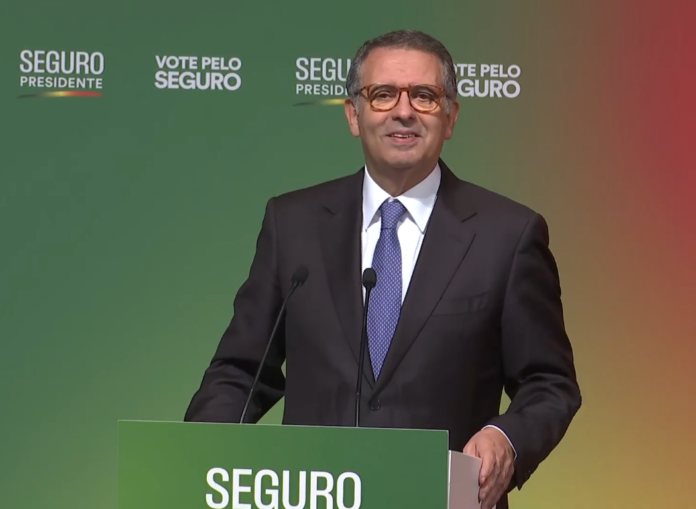
The outcome of the Portuguese election has reshaped the country’s political landscape and delivered a clear and decisive victory to center-left candidate António José Seguro. In a runoff election marked by extreme weather, high political stakes, and growing polarization, Portuguese voters overwhelmingly rejected the far right and opted for continuity, moderation, and institutional stability. With nearly all votes counted, Seguro ultimately secured roughly two thirds of the electorate and defeated far-right challenger André Ventura by a wide margin.
This result confirms Seguro as Portugal’s next president and underscores both the resilience of Portuguese democratic institutions and the increasing influence of populist forces that, while unsuccessful in this contest, continue to grow in strength.
Landslide Result in a High-Stakes Runoff
The Portuguese election culminated in the country’s first presidential runoff in four decades. After no candidate achieved an outright majority in the first round, the contest narrowed to Seguro of the Socialist Party and Ventura, the leader of the far-right Chega party. Final results showed Seguro winning approximately 66-67% of the vote compared with around 33-34% for Ventura.
Exit polls throughout election day consistently pointed to a comfortable victory for Seguro, and partial results confirmed that lead as counting progressed including in Lisbon and Porto. The margin of victory left little doubt about the national verdict and represented one of the most decisive presidential outcomes in recent Portuguese history.
Seguro becomes the first president from the socialist camp in two decades and will serve a five-year term beginning in early March. He will become the successor to the outgoing president Marcelo Rebelo de Sousa, who is completing his second and final term.
Turnout Holds Firm Despite Severe Storms
One of the defining features of this Portuguese election was the extraordinary context in which it took place. The runoff occurred amid a succession of powerful storms that caused flooding, infrastructure damage, and widespread disruption across much of the country. Several extratropical cyclones led to fatalities, power outages affecting more than 100,000 homes, and interruptions to public transportation networks.
Despite these challenges, voter turnout remained broadly consistent with the first round of voting held in January. More than 45% of eligible voters had cast ballots by late afternoon on election day, a participation rate significantly higher than comparable stages in previous presidential elections. While a small number of municipalities were permitted to delay voting by one week due to severe flooding, the postponement affected only a fraction of registered voters and did not alter the overall outcome.
The decision to proceed with the election nationwide, rather than delay it entirely, became a political flashpoint during the campaign. Ultimately, electoral authorities and the outgoing president insisted that postponement would violate electoral law and undermine democratic norms. The steady turnout suggested that voters largely accepted this position.
The Role and Power of the Portuguese Presidency
Although often described as ceremonial, the presidency in Portugal carries meaningful constitutional authority. The country operates under a semi-presidential system in which the president serves as head of state while executive power rests with the government. The president has the ability to appoint the prime minister, veto legislation, ratify international treaties, and appoint members of key judicial and state bodies.
Perhaps most significantly, the president holds the power to dissolve parliament and call early elections under certain conditions. This authority, sometimes described in political shorthand as the system’s ultimate safeguard, gives the presidency substantial influence during periods of political instability.
This context helped elevate the stakes of the Portuguese election. Portugal has experienced repeated legislative elections in recent years and currently has a center-right minority government that must negotiate parliamentary support issue by issue. Many voters viewed the presidency as a stabilizing force rather than an engine of confrontation.
Seguro’s Campaign of Moderation and Cooperation
António José Seguro ran his campaign as a candidate of moderation, institutional cooperation, and a continuation of democracy. A veteran figure in Portuguese politics, he positioned himself as someone capable of mediating disputes, easing tensions between branches of government, and acting as a guardian of democratic norms.
Crucially, Seguro attracted support not only from the traditional left but also from prominent figures on the center right who were concerned about the implications of a far-right presidency. His message emphasized collaboration with the existing minority government rather than obstruction or confrontation. This appealed to voters fatigued by years of political turbulence.
This broad coalition of support proved decisive in the runoff particularly as moderate voters from across the political spectrum mobilized to block Ventura’s path to the presidency.
Ventura’s Strong Showing Signals a Shift
While the Portuguese election ended in defeat for André Ventura, the result nevertheless marked a significant milestone for the far-right leader and his Chega party. Ventura achieved his strongest national result to date, secured more than one-third of the vote, and surpassed previous benchmarks for the performance of the far right in Portugal.
Chega, founded only a few years ago, has rapidly transformed from a fringe movement into the largest opposition force in parliament. Ventura’s campaign capitalized on dissatisfaction with political elites, concerns about immigration, and frustration with economic pressures. His rhetoric, often confrontational and deliberately polarizing, resonated with a growing segment of the electorate.
Ventura’s presence in the runoff itself was unprecedented in modern Portuguese politics and reflected broader European trends in which populist and nationalist movements have gained traction even in countries long resistant to far-right politics.
Implications for Portuguese Democracy
The outcome of the Portuguese election sends a two-pronged message. On one hand, the decisive victory for Seguro demonstrates that a strong majority of voters continue to favor moderation, democratic norms, and institutional stability. On the other hand, Ventura’s result confirms that the far right is no longer only a marginal minority in Portugal and cannot be dismissed as a temporary phenomenon.
Political analysts have noted that a far-right presidency would likely have strained Portugal’s institutional framework and intensified political conflict. By rejecting that path, voters reaffirmed the traditional role of the president as a unifying and moderating figure rather than an activist counterweight to parliament and government.
At the same time, Ventura’s growing support suggests that underlying social and political tensions remain unresolved. Issues such as immigration, economic inequality, and trust in political institutions will continue to shape Portuguese politics in the years ahead.
The Portuguese election also drew attention beyond the country’s borders. Portugal is a stable democracy within the European Union, and the contest was closely watched as another test of Europe’s ability to contain far-right populism through democratic means.
Seguro’s victory was widely interpreted as a reaffirmation of Portugal’s commitment to European values and multilateral cooperation. His presidency is expected to maintain Portugal’s current international position including its role within EU institutions and its approach to foreign policy and defense matters.
Looking Ahead to Seguro’s Presidency
As António José Seguro prepares to take office, expectations are centered on his ability to act as a steadying influence during a period of political fragmentation. While he has pledged not to act as a counterweight to the elected government, his role will involve vigilance, mediation, and, when necessary, firm use of constitutional powers.
The next five years are likely to test the balance between stability and change in Portuguese politics. The Portuguese election has clarified the public’s immediate preference, but it has also highlighted longer-term shifts that will shape future elections.
In the end, voters chose a moderate path forward, reaffirmed democratic institutions, and sent a strong signal about the kind of leadership they expect from the presidency. At the same time, the rise of the far right ensures that Portugal’s political conversation is far from over.