
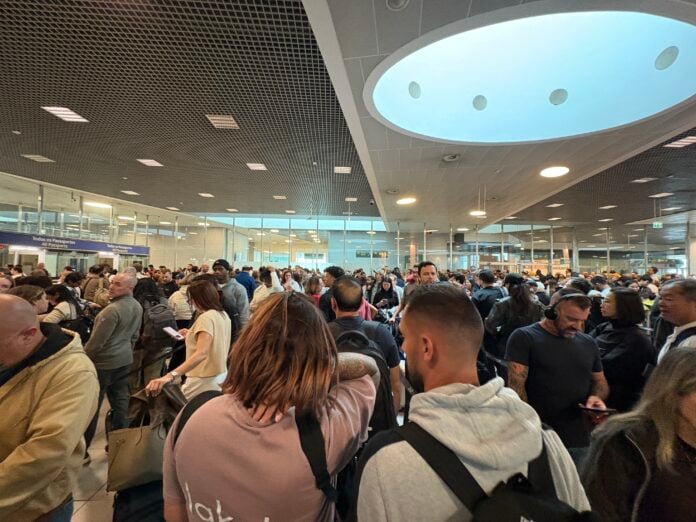
Just one week after we reported on the extremely long immigration lines, Lisbon’s Humberto Delgado Airport has temporarily suspended the rollout of Europe’s new biometric border control system after weeks of severe congestion exposed major weaknesses in its arrivals infrastructure. The pause will last three months and is intended to give authorities time to address staffing shortages, space constraints, and equipment limitations that left many travelers waiting for hours to enter Portugal.
Why the EU’s Entry Exit System Was Suspended
The suspension only applies to Lisbon’s Humberto Delgado Airport and took effect immediately. According to the Ministry of Internal Administration, the introduction of the European Union’s Entry Exit System placed unsustainable pressure on the arrivals area, namely for passengers entering from outside the Schengen zone. Officials said conditions had deteriorated to the point where contingency measures were necessary under EU regulations.
The Entry Exit System is designed to modernize border management across the European Union by replacing traditional passport stamps with biometric identification. Travelers are required to provide facial images and fingerprints, which allows authorities to track entry and exit dates electronically. While the system is meant to improve security and efficiency in the long term, its introduction in Lisbon has produced the opposite effect.
The system began operating at the airport in October, with a second phase introduced in December that expanded biometric data collection. Processing times increased significantly, and the arrivals area struggled to handle passenger volumes during one of the busiest travel periods of the year. By the holiday season, delays had become extreme, and some non EU passengers reported waiting up to seven hours to clear border control. This led to widespread frustration and passengers missing their connecting flights.
What Happens Next
In late October, the Government established an emergency task force to address the growing crisis. Despite the deployment of additional police officers for Christmas and New Year travel, conditions did not improve enough to stabilize operations. The decision was ultimately made to suspend the biometric system temporarily and return to the previous border control process.
During the suspension, travelers arriving from outside the Schengen area will be processed under the old system. This involves manual passport checks and physical entry stamps with border officers verifying identity and length of stay without biometric collection. Authorities believe this approach will significantly reduce processing times while longer term solutions are implemented.
The Government plans to use the three month window to reinforce staffing and expand equipment capacity. Members of the National Republican Guard have already been assigned to help with passport control duties in the arrivals area after receiving short operational training. Officials also confirmed plans to increase electronic and physical border control equipment capacity by approximately 30%.
In addition to immediate measures, longer term investments have been approved. A Council of Ministers resolution authorized the Public Security Police to spend 7.5 million euros between 2026 and 2028 on new equipment and systems aimed at expanding border control capacity and improving passenger flow. These upgrades are considered essential before the Entry Exit System becomes mandatory across the European Union.
A Surprise Inspection from European Authorities
The decision to suspend the system followed mounting scrutiny from European authorities. An unannounced inspection carried out in the middle of December identified serious deficiencies in Lisbon’s border operations. Inspectors cited long waiting times, overcrowded arrivals areas, and temporary procedural shortcuts that had been implemented without prior notification. These findings prompted demands for immediate corrective action and played a central role in the Government’s decision.
Following the announcement, European officials clarified that the suspension was not linked to technical failures in the Entry Exit System itself. Instead, they emphasized that the issues were related to local operational capacity. A new assessment of Lisbon airport is expected early in the year to evaluate whether corrective measures are sufficient.
The situation has reignited long standing disputes over responsibility for the airport’s problems. Police unions argue that officers are being blamed for structural and planning failures beyond their control. They point to limited space in the arrivals area, a restricted number of service counters, and unreliable electronic gates as key contributors to the delays.
The airport operator has countered that staffing shortages, inadequate planning, and instability in biometric gates are the primary causes of congestion. According to the operator, passengers frequently encounter closed booths and inactive gates, which creates visible bottlenecks and operational confusion.
Political Reaction to the Suspension of the EU Entry Exit System
Political reaction has been swift and critical. Opposition leaders accused the Government of failing to prepare adequately for a system that had been planned at the European level for years. They demanded explanations from the Prime Minister regarding potential security implications of suspending biometric border checks.
Police union leaders have also expressed concern and warned that pausing the system could weaken national security and delay compliance with EU deadlines. While acknowledging the severity of the operational crisis, they argue that suspension merely postpones an inevitable challenge. Portugal, like all EU member states, must have the system fully operational by April.
For now, the pause offers a welcome, albeit short-term, relief for travelers and businesses that rely on Lisbon as a key international gateway. However, authorities caution that delays may still occur while upgrades are underway. The next three months will be critical in determining whether Lisbon airport can meet European requirements without repeating the disruptions that led to this unprecedented decision. Time will tell whether the Lisbon Airport can finally rise to the challenge and meet the new EU requirements.