
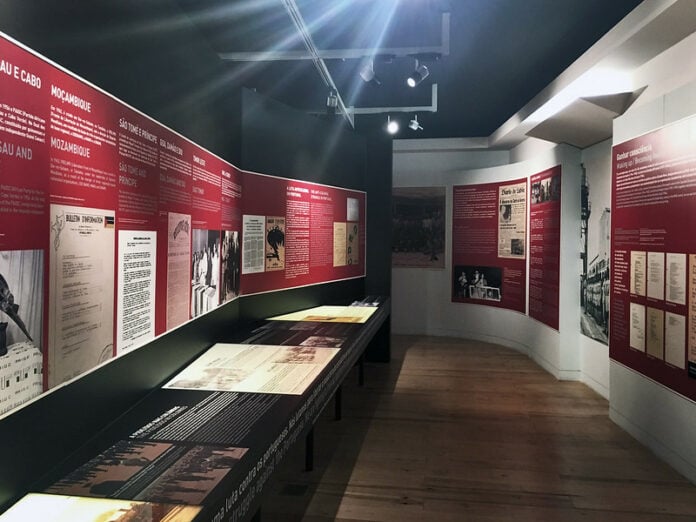
The Aljube Museum – Resistance and Freedom in Lisbon, also known as the Museu do Aljube Resistência e Liberdade, presents a stark reminder of beautiful Portugal’s ugly and turbulent past. Dedicated to the fight against one of the longest-lasting authoritarian regimes in 20th-century Europe, beginning with the Ditadura Militar in 1926 and evolving into the Estado Novo from 1933 to 1974, it offers a deep dive into a painful yet pivotal era.
This museum showcases the resilience and courage in the struggle for freedom and democracy, vividly narrating Portugal’s journey from oppression to liberation. Within its walls, visitors can explore the remnants of Portugal’s dark past, including the cells that once confined political prisoners, revealing a chilling narrative of resistance and hope.
History
The history of the Aljube building traces back to Roman and Islamic times. Originally named from the Arabic “al-jubb,” meaning a well without water, cistern, or dungeon, it has predominantly served as a prison. Over the centuries, it transformed from an ecclesiastical prison to a women’s prison, and notably, a political prison from 1928 to 1965. This evolution mirrors the changing societal and political landscapes of Portugal.
Adjacent to the Sé Catedral (Lisbon Cathedral), the Aljube became infamous as a political prison during António de Oliveira Salazar’s dictatorship from 1932 to 1968. The Estado Novo era under Salazar was a time of fear and oppression, with the government employing a vast network of informants and spies, reminiscent of Stasi-era Berlin.
The Aljube Museum, which opened on April 25, 2015, the 41st anniversary of the Carnation Revolution, vividly brings to life this era in Lisbon, telling the stories of prisoners, unions, students, and ordinary people who dared to resist the regime.
It celebrates the eventual collapse of the Estado Novo, culminating in the peaceful Carnation Revolution of 1974. The museum’s exhibits, including multimedia presentations, provide a comprehensive and emotional journey through this significant chapter in Portuguese history.
Architecture
Spread over five levels, the museum facilitates a journey through Portugal’s difficult history in chronological order from the basement of the building to the top floor. Visitors enter on Floor 0 but should first check out Floor -1 to see a small archaeology exhibit revealing the Aljube’s ancient foundations, dating back to at least the time of the Moors. Floor 0 contains the gift shop, concierge, and temporary exhibitions. The main entrance of the former Prison of Aljube, now closed, can also be seen at this level.
Floors 1 to 3 include the museum’s permanent collection, each dedicated to different aspects of the Portuguese dictatorial regime and the resistance against it. This includes a memorial to political prisoners, an exploration of censorship and political repression, and a tribute to the anti-colonial struggle. Additionally, the museum houses a specialized library and temporary exhibition spaces, offering a comprehensive educational experience.
The top floor celebrates the moment of revolution on April 25, 1974, and serves as a place of sanctuary after the difficult and emotionally draining stories of torture and oppression from the floors below. On the top floor, visitors can also find a narrow balcony offering a panoramic view of the Sé Catedral’s roof. Take some time here to recover from what you have just witnessed and reflect on how far Portugal has come today.
Visiting Times & Tickets
The Museu do Aljube Resistência e Liberdade is open:
Tuesday to Sunday – 10:00 AM–6:00 PM
Last admission – 5:30 PM
The museum is closed on:
- Mondays
- January 1
- May 1
- December 25
Ticket Prices
- Regular admission (ages 26–64) – €4
- Ages 13–25 – €2 (50% discount)
- Seniors aged 65+ who are not Lisbon residents – €2.80 (30% discount)
- Visitors with disabilities or specific needs – €2.80, with free admission for one accompanying person
- Public/private partnership and protocol discounts – up to 20%, reducing admission to €3.20
The museum’s temporary exhibitions are free to visit.
Free Admission
Free admission is available for:
- Children up to age 12
- Lisbon residents aged 13–23 through the Passe Cultura
- Lisbon residents aged 65+ through the Passe Cultura
- Unemployed residents of the municipality of Lisbon
- Lisbon residents on Sundays and public holidays until 2:00 PM
- April 25
- May 18 (International Museum Day)
- Members of APOM and ICOM
- Members of the Museu do Aljube Advisory Council
- Accredited researchers and teachers
- Journalists and registered tourism professionals while working, with appropriate professional identification
- EGEAC employees plus one accompanying person
- Regular users of the museum’s Documentation Centre and Library
- Institutional patrons designated by the EGEAC Board
- Performing arts professionals
Proof of eligibility is required for reduced-price and free tickets.
Payment Methods
The museum accepts:
- Cash
- Multibanco/debit card
- MB Way
Tickets can also be purchased online here through the museum’s official EGEAC/BOL ticketing service.
Guided Tours
The museum offers guided visits to its permanent and temporary exhibitions in Portuguese and English.
Organized visits are available for schools, universities, associations, community organizations, and informal groups. Advance booking is required, and all organized group visits, whether guided or self-guided, must be confirmed by the museum’s education service to prevent groups from overlapping inside the museum.
To arrange a group visit, email [email protected]. The museum currently asks that group bookings be made exclusively by email.
The museum also runs monthly guided visits for individual visitors, usually on a Saturday. These visits last approximately one hour and include Portuguese Sign Language (LGP) interpretation. For information and reservations, email [email protected].